
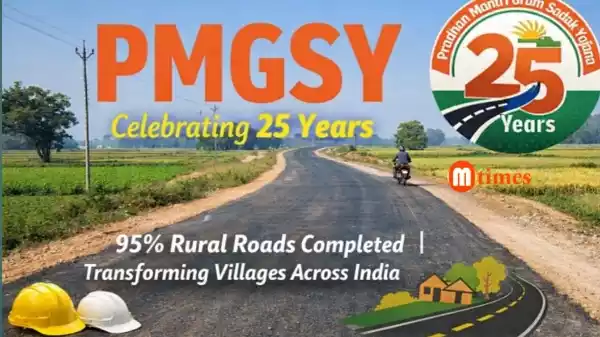

 has emerged as one of India’s most significant rural)
New Delhi: Celebrating its 25th anniversary in 2025, the Pradhan Mantri Gram Sadak Yojana (PMGSY) has emerged as one of India’s most significant rural infrastructure programmes. Launched to provide all-weather road connectivity to previously unconnected rural habitations, the scheme has played a crucial role in boosting agricultural productivity, generating employment, improving access to education and healthcare, and supporting poverty reduction in rural India.
Since its launch, PMGSY has approved a total of 8,25,114 kilometres of rural roads, out of which 7,87,520 kilometres have already been constructed. This translates to nearly 95 per cent physical progress as of December 2025, according to an official government statement issued on Thursday.
PMGSY 25 years milestone highlights rural connectivity success
The government has proposed the construction of an additional 62,500 kilometres of rural roads during the implementation period from FY 2024–25 to 2028–29. This phase carries a total financial outlay of ₹70,125 crore and aims to further strengthen rural infrastructure across the country.
Phase IV of the Pradhan Mantri Gram Sadak Yojana focuses on extending all-weather road connectivity to around 25,000 rural habitations that remain unconnected. Officials said this phase will play a vital role in bridging infrastructure gaps and enhancing socio-economic opportunities in remote and underserved regions.
Road infrastructure drives rural growth and livelihoods
Road connectivity forms a foundational pillar of rural development by enabling access to markets, schools, healthcare facilities, and other essential services. Improved rural roads help farmers secure better price realisation for their produce, reduce transportation costs, and expand access to non-farm employment opportunities.
Over the years, PMGSY has evolved into a powerful driver of socio-economic transformation. The programme has strengthened market integration, supported diversified livelihoods, and contributed significantly to inclusive and sustainable rural development. These outcomes highlight the scheme’s long-term impact on improving living standards in rural communities.
PMGSY 25 years backed by strong budgetary support
The government’s continued commitment to rural road development is reflected in recent budgetary allocations. For the financial year 2025–26, PMGSY has been allocated ₹19,000 crore, reinforcing the emphasis on enhancing all-weather rural connectivity and boosting economic activity in villages.
Systematic policy measures have also led to notable improvements in the quality, durability, and sustainability of rural roads built under the programme. The statement noted that close monitoring and strong institutional mechanisms have helped maintain construction standards while ensuring timely project execution.
Digital monitoring ensures transparency and quality
Progress under PMGSY is closely tracked through advanced digital platforms and monitoring systems to ensure efficiency, transparency, and accountability. The Online Management, Monitoring, and Accounting System (OMMAS) enables real-time tracking of both physical and financial progress of road projects, ensuring alignment with targets set for states.
To further strengthen project oversight, the Project Management Information System (PMIS) has been integrated into OMMAS. This integration allows more effective management of construction activities for every road sanctioned under PMGSY-III.
OMMAS also supports quality assurance by capturing inspection reports from independent quality monitors. Assessments conducted by National Quality Monitors (NQMs) and State Quality Monitors (SQMs) are uploaded through the Quality Monitoring System (QMS) mobile application, along with geo-tagged field photographs, and are reflected on the OMMAS portal. This framework enables real-time quality checks and enhances transparency.
Additionally, the Electronic Maintenance of PMGSY Roads (e-MARG) platform has been rolled out across all states to monitor road maintenance for five years following project completion, corresponding to the Defect Liability Period (DLP). With maintenance payments now linked to road performance through e-MARG, contractor accountability has increased, maintenance standards have improved, and the long-term durability of PMGSY assets has been significantly strengthened, the statement added.
You May Like
Trending Searches Today |
- IBPS Clerk Recruitment 2026 Registration Begins August 1, Check Exam Schedule
- Former DFO Sangram Behera Surrenders in ACF Soumya Ranjan Death Case
- NDA MPs Welcome Dharmendra Pradhan in Parliament After Resignation
- Madanapalle Moves Closer to Zero Waste City Goal Under SBM-U 2.0
- Naveen Patnaik Demands Nityananda Gond’s Resignation Over Textbook Errors