
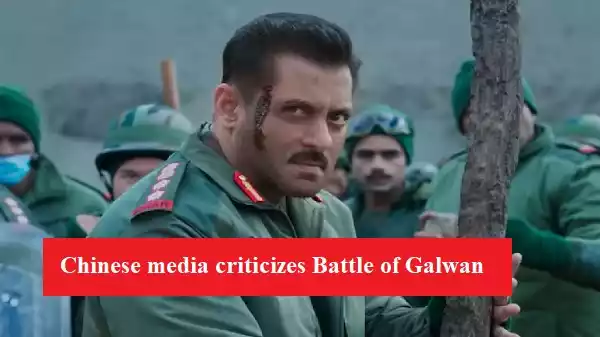


New Delhi: India issued a strong rebuttal to criticism from China’s state-run newspaper Global Times over the forthcoming Bollywood film Battle of Galwan, firmly asserting that creative freedom is a core principle of Indian cinema and cannot be shaped by foreign political sensitivities.
Government sources said that films inspired by India–China military encounters are not new and have been part of Indian cinema for decades. They cited earlier productions such as Haqeeqat, based on the 1962 war, and 121: Battle of Rezang La as examples of filmmakers engaging with sensitive chapters of military history.
According to officials, storytellers are entitled to explore narratives they believe are significant, and such artistic expression should not be politicised. The response came after Global Times published an article criticising the teaser of Battle of Galwan, accusing the film of misrepresenting the June 2020 clash in eastern Ladakh’s Galwan Valley.
Battle of Galwan Film Row Highlights India’s Stand on Creative Freedom
The Global Times report alleged that the teaser distorts facts surrounding the Galwan clash and questioned the portrayal of Indian Army officer Colonel Bikkumalla Santosh Babu, who lost his life during the confrontation. It claimed that Chinese social media users viewed the film as exaggerated and repeated Beijing’s long-standing position that India provoked the clash by crossing the Line of Actual Control.
The Chinese publication further accused India of overstating casualty figures and alleged that the film was intended to damage the image of the People’s Liberation Army, despite the fact that China officially acknowledged its own fatalities much later.
Indian sources categorically rejected these allegations, maintaining that the government has no involvement in the production of the film and fully upholds freedom of expression. They added that individuals seeking official clarification on historical or military facts may approach the Ministry of Defence.
Film Based on Real Events and Documented Accounts
Battle of Galwan is based on the real-life confrontation involving the Indian Army’s 16 Bihar Regiment during the 2020 standoff. The film draws from the book India’s Most Fearless 3 by journalists Shiv Aroor and Rahul Singh, which documents accounts of bravery and military operations.
Also Read | Why Plant Based Milk Is Taking Over American Kitchens in 2025
Bollywood actor Salman Khan portrays Colonel Santosh Babu in the film, bringing to screen the story of an officer widely recognised for his leadership and sacrifice. Officials noted that adapting documented accounts into cinema is a creative choice and does not equate to an official government narrative.
Battle of Galwan Film Row Reinforces India’s Clear Message to China
Indian officials underlined that New Delhi’s position is unambiguous: cinema is an artistic medium, not an extension of diplomacy. Creative freedom, they stressed, will not be compromised to align with external narratives or political pressure.
By pushing back against the criticism, India has reiterated that its filmmakers are free to interpret historical events through their creative lens, and such expression remains protected within the country’s democratic framework.
You May Like
Trending Searches Today |
- Sensex, Nifty Recover as FMCG, Energy and Banks Lead Gains
- Odisha CM Launches Jeevan Jindabad 2.0 Campaign, Addiction-Free Odisha
- Next-Gen GST Reforms to Focus on Registration, Refunds and ITC: FM
- Odisha Student Union Elections to Be Held on October 15 After 8 Years
- Raj, Uddhav Thackeray Lead Mumbai Garjana Morcha; Targets Election Commission
Amazon Online Shopping