

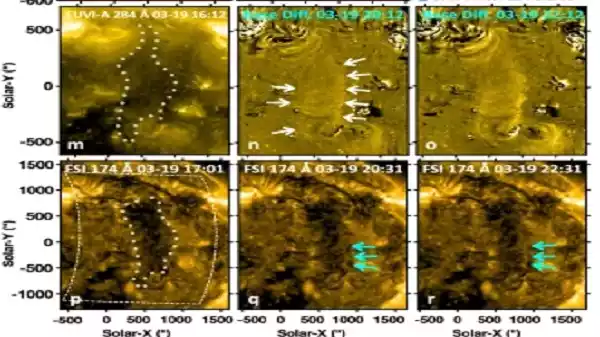

- A Stealth Coronal Mass Ejection caused the intense geomagnetic storm in March 2023.
- The eruption traveled through a coronal hole, boosting its impact on Earth.
- Researchers warn stealth CMEs are difficult to detect, complicating space weather forecasts.
Astronomers have confirmed that a Stealth Coronal Mass Ejection was responsible for the powerful geomagnetic storm that struck Earth in March 2023.
The discovery highlights a growing challenge for scientists trying to predict dangerous space weather events before they disrupt modern technology.
Unlike typical solar eruptions, this CME left almost no visible warning signs, allowing it to reach Earth unnoticed until it triggered severe geomagnetic disturbances.
How the Stealth Coronal Mass Ejection Escaped Detection
Coronal Mass Ejections are giant bursts of plasma and magnetic energy released from the Sun’s atmosphere.
They can interfere with satellites, radio communications, navigation systems, and even electrical power grids on Earth.
However, researchers note that nearly 10% of major geomagnetic storms do not come from obvious solar explosions. Instead, they originate from faint eruptions known as stealth CMEs.
These subtle events often lack telltale markers like X-ray flares or radio bursts, making them extremely difficult to identify with standard monitoring tools.
Coronal Holes Helped the Solar Eruption Reach Earth
The March 19, 2023 stealth CME was able to travel through space because of a nearby coronal hole.
Coronal holes are openings in the Sun’s magnetic field that release fast-moving solar wind streams.
Scientists found that this high-speed solar wind acted like a conveyor belt, accelerating the weak eruption and allowing it to maintain strength instead of dissipating near the Sun.
This combination enabled the eruption to hit Earth about three days later, producing a surprisingly intense geomagnetic storm.
Spacecraft Tracking of the Stealth Coronal Mass Ejection
To study the eruption, astronomers used observations from multiple spacecraft, including:
- NASA’s Solar Dynamics Observatory (SDO)
- Solar Orbiter (SolO)
- STEREO-A
- WIND mission
These instruments tracked the interplanetary CME as it moved outward behind a high-speed solar wind stream.
Also Read | India AI Ecosystem Gets Major Push as PM Modi Meets Leading AI Start-ups
Unlike stronger eruptions, this one arrived without the typical shock wave or dense sheath region, making its detection even more challenging.
Why Forecasting Stealth Coronal Mass Ejection Storms Is So Difficult
Researchers at the Indian Institute of Astrophysics modeled the storm using solar wind speed, plasma density, and magnetic field direction.
They found that including electric field variations and solar wind density was crucial for matching real geomagnetic storm measurements.
The findings confirm that even weak and nearly invisible eruptions can become dangerous when paired with favorable solar wind conditions and southward magnetic fields.
Scientists warn this complex behavior makes predicting stealth CME-driven space weather one of the biggest challenges for future forecasting systems.
You May Like
Trending Searches Today |
- Odisha to Launch ‘Ama Rasta’ WhatsApp Chatbot for Road Accident Response
- NSE IPO GMP Falls to ₹55 Ahead of Allotment and Listing
- Odisha Heavy Rain Alert: Bay of Bengal System May Become Deep Depression
- Odisha Final Voter List 2026: 3.16 Crore Electors After SIR, What to Do If Your Name Is Missing
- Mahanadi Water Dispute: Odisha, Chhattisgarh Move Toward Settlement


