

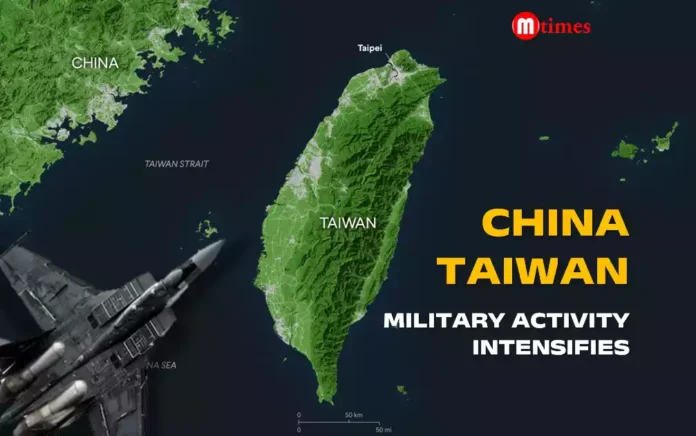

- Taiwan detected Chinese aircraft, naval vessels, and official ships near its territory
- All reported PLA aircraft entered Taiwan’s southwestern ADIZ
- Continued incursions signal sustained pressure rather than isolated military movement
The latest surge in China Taiwan military activity has once again heightened tensions across the Taiwan Strait, as Taiwan’s Ministry of National Defense reported multiple Chinese military aircraft and vessels operating near the island.
According to Taiwan, four Chinese aircraft sorties, five naval vessels, and two official ships were detected by Friday morning, with all aircraft entering Taiwan’s southwestern Air Defense Identification Zone (ADIZ).
This follows similar activity a day earlier, suggesting a pattern of sustained military signaling rather than random patrols.
China Taiwan Military Activity: Why These Incursions Matter
While such sorties do not necessarily indicate immediate conflict, they serve several strategic purposes for Beijing.
These operations can:
- Test Taiwan’s defense response times
- Increase military and psychological pressure
- Reinforce sovereignty claims
- Normalize Chinese presence near contested zones
This strategy matters because repeated incursions can gradually reshape the security environment without direct escalation into open conflict.
Why Taiwan’s Southwestern ADIZ Is Frequently Targeted
Taiwan’s southwestern ADIZ is a strategically sensitive zone due to its proximity to key air and maritime pathways.
Chinese aircraft entering this region often force Taiwan’s military to monitor, scramble, and respond, creating both operational strain and strategic messaging.
This is part of a broader gray-zone pressure tactic, where military force is used below the threshold of war.
Historical Context Behind China’s Taiwan Position
Beijing’s position is rooted in its “One China” principle, under which Taiwan is viewed by the People’s Republic of China as part of its sovereign territory.
Taiwan, however, functions with:
- Its own government
- Independent military
- Separate economy
- Democratic political system
This creates one of the world’s most sensitive sovereignty disputes, where military signaling often carries geopolitical consequences beyond the region itself.
Second-Order Effects on Indo-Pacific Security
Repeated Chinese military activity near Taiwan affects more than bilateral relations.
It also shapes:
- US strategic calculations
- Regional military preparedness
- Japan’s security outlook
- Global semiconductor market confidence
Because Taiwan plays a central role in global chip manufacturing, prolonged instability could eventually influence supply chains far beyond Asia.
Why This Is About More Than Military Movement
Each new sortie or vessel presence contributes to a larger strategic pattern, gradual normalization of Chinese military proximity.
If these operations become increasingly routine, they may shift international perception of acceptable operational space around Taiwan.
That is why Taiwan’s public reporting and response are also part of a broader deterrence narrative.
The core risk lies not only in deliberate escalation, but also in miscalculation.
Frequent military encounters increase the chance of:
- Airspace incidents
- Navigation disputes
- Diplomatic escalation
The China Taiwan military activity reported this week reinforces a broader reality, the Taiwan Strait remains one of the most consequential geopolitical flashpoints in the world, where recurring pressure operations could shape future regional security architecture.
You May Like
Trending Searches Today |
- IIIT Ranchi Student Found Dead in Hostel, Students Protest
- Odisha Police Tighten Security Ahead of October 15 Student Elections
- US Eases Russian Diesel Sanctions Until April 2027
- Mahalaya Begins Durga Puja Countdown Across India
- Odisha Plans New ABADHA-Like Scheme for Puri Development
Amazon Online Shopping


