
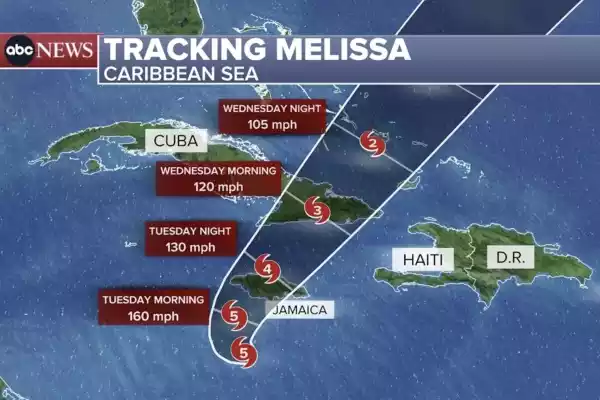

Hurricane Melissa has intensified into a powerful Category 5 storm, putting the Caribbean on high alert for widespread devastation. With sustained winds reaching 160 mph (257 km/h), the storm poses severe threats to Jamaica and neighbouring islands. The U.S. National Hurricane Center (NHC) has issued warnings for flash floods, storm surges, and extended power outages, highlighting the catastrophic potential of a hurricane of this magnitude.
How a Hurricane Forms
Hurricanes begin as clusters of thunderstorms over tropical waters warmer than 26.5°C. As moist air rises, it creates a low-pressure area that draws in cooler air, fueling a continuous cycle of cloud formation and wind intensification. When wind speeds exceed 74 mph (120 km/h), the weather system is officially classified as a hurricane. These massive rotating storms act as natural engines, transforming ocean heat into immense kinetic energy that can span hundreds of kilometres.
Hurricanes, Cyclones, and Typhoons: Same Storm, Different Names
While hurricanes, cyclones, and typhoons are the same type of storm, their names depend on location. Hurricanes occur in the North Atlantic and Northeast Pacific, cyclones develop in the South Pacific and Indian Ocean, and typhoons form over the Northwest Pacific. The Coriolis effect determines their rotation, causing hurricanes to spin anticlockwise in the Northern Hemisphere and clockwise in the Southern Hemisphere.
The Saffir–Simpson Hurricane Wind Scale Explained
The Saffir–Simpson scale categorises hurricanes into five levels based on sustained wind speeds, each reflecting the degree of expected damage.
Category 1 (74–95 mph): Dangerous winds causing minor roof and tree damage.
Category 2 (96–110 mph): Extensive structural and power line damage.
Category 3 (111–129 mph): Major hurricane capable of severe building damage.
Category 4 (130–156 mph): Catastrophic winds destroying most roof structures.
Category 5 (157 mph+): Total devastation with widespread destruction and long-term uninhabitability.
Hurricane Melissa’s current classification as Category 5 places it at the most extreme level, signifying immense destructive potential and risk to life.
Impact and the Debate on Category 6
The true danger of hurricanes extends beyond strong winds to include storm surges, flash floods, and landslides — factors responsible for most hurricane-related fatalities. Past storms like Katrina (2005) and Irma (2017) have shown how flooding and infrastructure collapse can amplify destruction. Although the Saffir–Simpson scale currently stops at Category 5, some experts have proposed introducing a Category 6 to account for increasingly powerful storms driven by climate change. As Hurricane Melissa barrels through the Caribbean, it underscores the escalating impact of global warming and the urgent need for stronger, more resilient coastal infrastructure worldwide.
Get Latest News Live on MTIMES along with Breaking News and Top Headlines, Political News and around The World.
You May Like
Trending Searches Today |
Odisha SSB Lecturers Protest for UGC Pay Parity and Service Recognition
Donald Trump’s 100% Tariffs on Indian Pharma Exports to US Spark Market Concerns
BSNL 4G Services at ₹1: Apply Now Free 30-Day Offer Diwali Bonanza Plan
Indian Army and BSF Personnel Celebrated Diwali Along Border Areas
Thamma Box Office: Ayushmann Khurrana’s Biggest Opener Set to Break Records
PM Modi Highlights Role of AI in Unlocking India’s Ancient Manuscripts