


KEY TAKEAWAYS:
• A report warns that US reluctance to confront China weakens Indo-Pacific security.
• The India Australia Japan trilateral is seen as a practical alternative deterrence mechanism.
• Regional democracies may need to shoulder greater responsibility without US leadership.
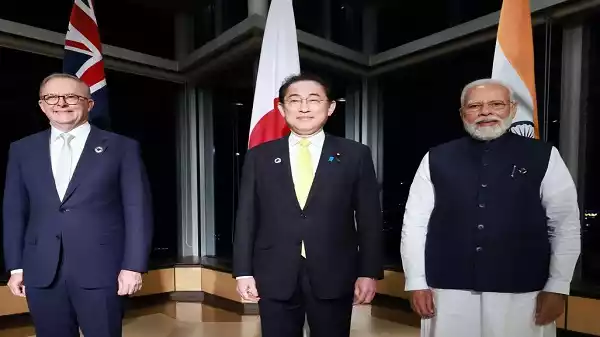
Tokyo: The India Australia Japan trilateral should be urgently revitalised to safeguard stability in the Indo-Pacific as the United States shows reduced willingness to counter Chinese coercion under Donald Trump, according to a strategic analysis published in Modern Diplomacy. The report argues that Washington’s shifting posture has created a security vacuum that regional democracies can no longer ignore.
It contends that unlike during the Cold War, when the US served as the primary guarantor of allied security, America’s current approach signals an erosion of reliability in the Indo-Pacific.
US Commitment to Indo-Pacific Questioned
The analysis highlights growing uncertainty around America’s role in confronting China’s maritime and strategic pressure. It notes that the US has slowed engagement in several regional “minilateral” frameworks originally designed to counter Beijing’s influence.
This hesitation, the author argues, undermines deterrence and leaves frontline states increasingly exposed to coercive tactics from China.
Quad Uncertainty Adds to Strategic Vacuum
India, Australia and Japan are all members of the Quadrilateral Security Dialogue, alongside the US. However, uncertainty has grown over Washington’s commitment, particularly after the postponement of the 2025 Quad Summit, which India was scheduled to host.
Also Read | India-US Trade Deal First Tranche Nears Finalisation as Talks Continue on Tariff Relief
Questions have also emerged over President Trump’s future participation in Quad engagements, with mixed signals from the US diplomatic establishment reinforcing doubts about continuity.
Strategic Opening for IAJ Cooperation
According to the report, this uncertainty creates space for the India Australia Japan trilateral to emerge as an autonomous and regionally grounded security mechanism, independent of US leadership. While acknowledging that the grouping lacks the military heft of US-backed alliances, the analysis stresses that deterrence is not purely about firepower.
Perception, coordination, and political signalling, it argues, are equally vital in shaping China’s strategic calculations.
Maritime Security at the Core
The report places maritime security at the centre of trilateral cooperation, citing China’s expanding naval presence across the Indo-Pacific. Each country faces pressure in different theatres—India in the Indian Ocean Region, Australia in the Western Pacific, and Japan in the East and South China Seas.
By synchronising efforts across these zones, the three democracies could collectively strengthen resistance to maritime coercion and reinforce regional stability.
The analysis concludes that as US leadership becomes less predictable, the burden of maintaining a free and open Indo-Pacific may increasingly fall on regional partners acting together rather than waiting for Washington to lead.
You May Like
Trending Searches Today |
- India Rejects China Renaming Arunachal as ‘Fictitious’ Claim
- US Blockade Strait of Hormuz Announced After Failed Iran Talks: President Trump
- Asha Bhosle Death Marks End of Golden Era in Indian Music
- Supreme Court SIR Electoral Rolls Case Set for Key Hearing Ahead of Bengal Polls
- Amarnath Yatra 2026 Dates Announced, Registration Starts April 15
Amazon Online Shopping