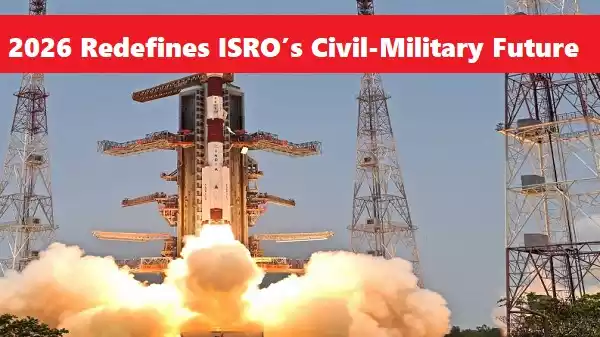


Bangalore: The year 2025 will be etched in the history of the Republic of India as the moment it executed its first high-technology, precision-strike operation of an escalatory nature Operation Sindoor against Pakistan, widely regarded as a global epicentre of terrorism. Central to the success of this operation was India space security strategy, which played a decisive role through advanced space-enabled intelligence, surveillance, and targeting capabilities.
In a significant shift from its traditionally restrained communication approach, ISRO publicly acknowledged the role of space-based assets in enabling pinpoint strikes on terror-linked military installations deep within hostile territory. This understated but powerful admission confirmed what many experts had long inferred: India has formally entered an era of civil-military fusion in space operations.
India Space Security Strategy and a Shifting Global Order in 2026
The year 2026 is poised to become a turning point for India’s space programme as it responds to a rapidly transforming global environment. The world today faces four interlinked challenges reminiscent of the 1930s: prolonged geopolitical conflict, demographic disruption, slowing economic growth in the West, and the gradual erosion of institutions that once upheld the post–20th century world order.
These pressures are fuelling protectionism and strategic self-reliance across major economies. A telling example is the United States’ growing defence posture signalling preparedness for deglobalisation and a multipolar geoeconomic reality. Europe, too, is transitioning toward a war-oriented economy. Together, these shifts are expected to place strain on the globalised space economy in 2026, forcing countries like India to rethink collaboration models and strategic dependencies.
Rethinking Commercial Space Partnerships and Strategic Autonomy
Over the past five years, India’s commercial space sector has expanded rapidly, seeking long-term integration with Western space markets. However, international reactions to Operation Sindoor have served as a sobering reality check. Both the Department of Space and private space companies are now reassessing international cooperation frameworks.
Also Read | DoT Releases NFAP 2025 to Strengthen India’s Spectrum Policy for 5G, 6G, Satellites
Going forward, India is expected to prioritise partnerships with nations that demonstrate genuine strategic alignment and long-term interest in India’s growth. As the world’s fastest-growing large economy and a key pole in the emerging multipolar order, India must carefully evaluate sovereignty, self-reliance, and resilience across space technology, telecommunications, and the space supply chain.
India Space Security Strategy Shapes Gaganyaan and Orbital Sustainability
In 2026, India will move decisively ahead with its Gaganyaan human spaceflight missions, including preparations for the Bhartiya Antriksh Station. The safety of Indian vyomanauts, particularly in low-Earth orbit, will intensify scrutiny of the growing congestion caused by indiscriminately deployed satellite constellations.
Both the Chinese space station and the International Space Station are already grappling with risks posed by orbital debris and overcrowding. With major constellations controlled by rival geopolitical blocs, global consensus on orbital sustainability remains elusive. In this context, Gaganyaan must transcend symbolism and serve a larger purpose—ensuring secure, sustainable, and equitable access to outer space for India and the international community.
New Launch Capabilities and Breakthrough Indigenous Technologies
The year 2026 will also mark major advances in India’s launch and technology capabilities. The first commercial launch of the Small Satellite Launch Vehicle, manufactured by Hindustan Aeronautics Limited, is scheduled alongside Skyroot Aerospace’s inaugural orbital flight of Vikram-1. Together, these platforms will give India flexible, on-demand launch options for small satellites.
Additionally, progress is expected on a defence-focused solid-fuel small satellite launcher, informally known as VEDA, designed for rapid-response missions. ISRO will also unveil cutting-edge indigenous technologies, including travelling-wave tube amplifiers for advanced communications, quantum key distribution for encrypted links, and high-thrust electric propulsion systems for agile satellites and deep-space missions. Many of these innovations are set to become standard across future Indian spacecraft.
The long-standing separation between civilian, commercial, and military space objectives is rapidly dissolving. By 2026, a fully integrated civil-military space framework aligned with national security and strategic interests will clearly define India’s ascent as a major space power.
You May Like
Trending Searches Today |
- Odisha Rain Alert IMD Thunderstorm Warning: 7 Days of Lightning, Gusty Winds Ahead
- March 28 2026 Daily Horoscope: Focus, Money, Love Signals
- Petrol Diesel Excise Duty Cut India: Govt Slashes Taxes to Tackle Oil Crisis
- Orissa High Court Penalty Delay Order: Officer Fined ₹1 Lakh for Ignoring Court Timeline
- Odisha Artificial Shortage Crackdown: Govt Moves to Secure Fuel and LPG Supply
Amazon Online Shopping