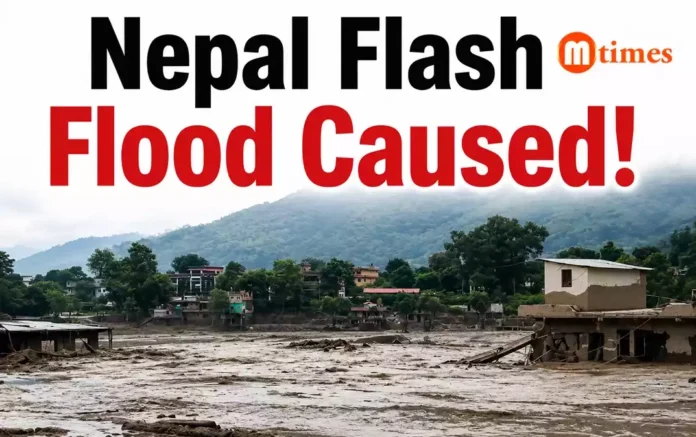

- A major glacier collapse reportedly triggered the Nepal flash flood 2026.
- Falling ice, rocks and mud temporarily blocked a mountain river.
- The natural barrier eventually failed, releasing a powerful surge of water and debris.
New Delhi: The catastrophic flash flood that struck the Nepal-Tibet border region on August 26, 2026, was reportedly the result of a chain reaction that began high in the Himalayas.
A large section of glacier and surrounding rock broke away from the mountain, sending enormous quantities of ice, rocks and mud into the river valleys below.
Glacier Collapse Triggered the Avalanche
The first stage of the disaster was the sudden collapse of a high-altitude glacier.
The tremendous force of the falling material generated ground vibrations. The resulting seismic signal was initially interpreted locally as possible earthquake activity.
However, the major event was associated with the collapse and subsequent movement of ice and rock rather than a conventional earthquake.
How the Temporary Dam Formed
The avalanche pushed huge quantities of ice, mud and rocks into the Lhende Khola and Bhote Koshi river valleys.
The debris effectively created a temporary natural dam, restricting the normal flow of the river.
Water then began accumulating behind this unstable barrier.
Why the Flood Became So Destructive
The temporary barrier could not withstand the increasing pressure indefinitely.
When it eventually broke apart, the stored water rushed downstream with enormous force, carrying rocks, mud and other debris along with it.
This created a destructive debris flow that behaved almost like a moving mass of concrete, making it extremely difficult for people downstream to escape once the surge began.
The resulting flood reportedly damaged villages, roads and bridges in the affected border region.
Did Climate Change Play a Role?
The disaster has also raised questions about the changing conditions in the Himalayan region.
The Himalayas are experiencing significant warming, and higher temperatures can accelerate the melting of snow and ice. Meltwater can enter cracks within glaciers and surrounding rock, potentially weakening these structures.
During the monsoon season, additional rainfall and water accumulation can further increase instability.
This does not mean that every glacier collapse is directly caused by climate change. However, scientists have warned that a warming Himalayan environment can increase the instability of glaciers and create greater risks from ice avalanches, landslides and sudden floods.
A Chain Reaction Turned Into a Flash Flood
The Nepal flash flood 2026 can therefore be understood as a sequence of events:
Glacier collapse → ice-rock avalanche → river blockage → temporary natural dam → water accumulation → dam failure → massive downstream flood.
The incident demonstrates how a relatively small area of instability high in the mountains can rapidly develop into a major disaster for communities located many kilometres downstream.
As Himalayan temperatures continue to change, monitoring glaciers, unstable slopes and mountain rivers will remain increasingly important for early warning and disaster preparedness.
You May Like
Trending Searches Today |
- Odisha Plans New ABADHA-Like Scheme for Puri Development
- IMD Thunderstorm Alert: 25 Odisha Districts on Watch
- BJD Says It Maintains Distance From BJP and Congress, Not Part of INDIA Bloc
- Puri Records 36.6°C as Heat and Humidity Persist, Coastal Odisha To Face Intense Heat
- West Bengal to Recruit 14,454 Government Post, To Provide Rs 50,000 For Unmarried Women
Amazon Online Shopping