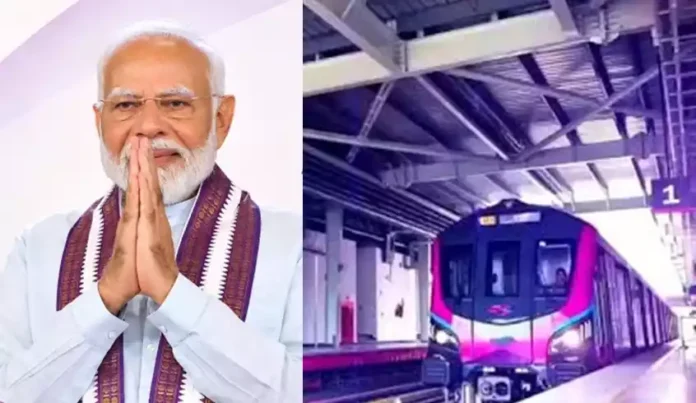

- PM Modi inaugurated the 23-km Pune Metro corridor connecting Hinjewadi and Shivajinagar. Passenger services will begin on November 4 at 17 stations.
- Foundation stones were laid for four additional Metro corridors under Phase II.
- The Pink Line will be operated entirely by women train operators, with around 30 per cent of its electricity requirements planned from solar power.
Pune: Prime Minister Narendra Modi on Tuesday virtually inaugurated Pune Metro’s 23-kilometre Line 3, popularly known as the Pink Line, and laid the foundation stone for four additional corridors under Phase II, marking a major expansion of the city’s public transport network.
The Pink Line has been built at a cost of more than ₹8,300 crore and connects Maan in the Hinjewadi IT hub with the District Court Metro station at Shivajinagar.
The four new corridors under Phase II involve an estimated investment of around ₹13,500 crore. Together, the inaugurated line and proposed expansion represent an investment of approximately ₹21,800 crore.
Addressing the gathering through video conferencing, Modi said improved Metro connectivity would support Pune’s economic growth, reduce commuting difficulties and improve the quality of urban life.
Pune Metro Pink Line to Open for Passengers on November 4
The 23-kilometre Pink Line is expected to provide significant relief to IT professionals, students and daily commuters travelling between Hinjewadi and central Pune.
The corridor has 23 stations. Passenger services are scheduled to begin on November 4, initially covering 17 stations. The remaining six stations will become operational in phases by January 2027.
The new route will connect a major employment hub with the city’s administrative and commercial centre. It will also integrate with the existing Metro network at the District Court interchange.
The improved connectivity is expected to reduce dependence on private vehicles, ease traffic congestion and provide commuters with an alternative to road transport.
Four New Metro Corridors Under Phase II
Along with inaugurating the Pink Line, the Prime Minister laid the foundation stone for four additional corridors under Pune Metro Phase II.
The proposed routes are:
- Line 2A: Vanaz to Chandani Chowk.
- Line 2B: Ramwadi to Vitthalwadi.
- Line 4: Kharadi to Khadakwasla.
- Line 4A: Nal Stop to Manik Baug.
Lines 2A and 2B together will cover approximately 12.75 kilometres. Line 4 will extend around 25.52 kilometres, while Line 4A will cover approximately 6.12 kilometres.
The expansion will connect important residential, commercial and employment centres, including Kharadi, Magarpatta, Hadapsar, Swargate, Manik Baug, Nanded City, Pune Cantonment and Warje.
The proposed corridors will also integrate with the existing Metro network and intercity bus services through interchange facilities at Swargate, Nal Stop and Kharadi Bypass.
Pink Line to Be Operated Entirely by Women
A distinctive feature of Pune Metro’s Pink Line is that it will be operated entirely by women train operators.
The initiative is being highlighted as an important step towards greater women’s participation in public transport operations.
The project also includes an environmental sustainability component. Around 30 per cent of the corridor’s electricity requirements are envisaged to be met through solar power.
These measures are expected to support more sustainable and inclusive urban transport operations.
Modi Highlights Pune’s Economic Importance
During the programme, Modi described Pune as an important centre for technology, manufacturing, pharmaceuticals, startups and innovation.
He said modern transport infrastructure was essential to support the city’s growing economic activities and expanding population.
The Prime Minister also called for developing smaller cities across the country as new centres of economic growth, rather than concentrating development only in major metropolitan areas.
Maharashtra Chief Minister Devendra Fadnavis and other state and Union government representatives were associated with the programme.
Pune’s Metro Network Set for Major Expansion
Pune has experienced rapid urbanisation and growing demand for reliable public transport. Increasing vehicle ownership and the concentration of employment opportunities in IT and commercial hubs have added pressure to the city’s road network.
The newly inaugurated Pink Line and the four proposed Phase II corridors are expected to strengthen connectivity between residential areas, workplaces and commercial centres.
However, the long-term benefits will depend on timely construction, effective integration between routes, reliable services and affordable fares.
You May Like