
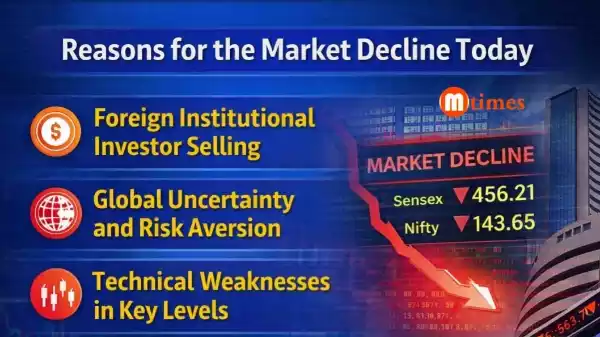


Mumbai: On January 14, 2026, the Indian stock market extended its losing streak for a second consecutive session. The BSE Sensex dropped 244.98 points (0.29%) to settle at 83,382.71, while the NSE Nifty 50 declined by 66.70 points (0.26%), closing at 25,665.60.
The Indian stock market today ended on a weaker note on Wednesday, extending the cautious mood that has dominated recent trading sessions. Benchmark indices faced steady pressure through the day, with investors remaining wary amid a mix of domestic headwinds and global uncertainties.
Market participants said the tone remained defensive as risk appetite stayed muted and selling pressure persisted in heavyweight stocks.
Indian Stock Market Today Opens Weak, Struggles to Recover
The domestic equity market opened firmly in negative territory, with both the BSE Sensex and the NSE Nifty50 slipping below their previous closing levels at the start of trade. Early losses saw the Nifty fall below the psychologically important 25,700 mark, while the Sensex declined by more than 100 points, signalling subdued investor sentiment from the outset.
As the session progressed, the indices moved within a narrow range, attempting intermittent recoveries. However, buying interest remained limited, and the broader undertone stayed weak, preventing any meaningful turnaround.
Foreign Investor Selling Weighs on Market Sentiment
By the closing bell, the Sensex had declined by a few hundred points, while the Nifty settled below the key 25,700 level. Market observers attributed the decline largely to continued foreign institutional investor (FII) selling, which has been a persistent theme in January.
Also Read | Best 5 Stocks to Buy Long-Term
The ongoing reduction in foreign exposure to Indian equities weighed on market breadth, with selling pressure visible across multiple sectors and market capitalisations. Several index heavyweights struggled to hold gains, contributing to the overall weakness.
Key Support Levels in Focus for Investors
As markets closed, investors remained cautious, closely tracking crucial technical support levels. Analysts said the 25,600 zone on the Nifty and levels just above 83,000 on the Sensex are emerging as important near-term supports. A decisive break below these levels could open the door for further downside in the coming sessions.
On the upside, experts noted that any sustained recovery above these levels could encourage bargain hunting and renewed buying interest, particularly from investors looking for value opportunities after the recent correction.
For now, the Indian stock market today reflects a wait-and-watch approach, with traders and investors closely monitoring global cues, foreign fund flows and domestic triggers for clearer direction.
Top 5 Reasons for the Market Decline Today
- U.S. Trade and Tariff Concerns:
Investor sentiment remains fragile due to uncertainty surrounding potential U.S. trade policies. Reports of potential 500% tariffs on countries purchasing Russian oil, along with an upcoming U.S. Supreme Court ruling on “Liberation Day” tariffs, have raised fears of a trade hit to India.
- Persistent Foreign Outflows:
Foreign Institutional Investors (FIIs) continued their aggressive selling trend. In the previous session alone, FIIs offloaded equities worth approximately ₹1,500 crore, bringing the total selling for January 2026 to over ₹18,000 crore.
- Geopolitical Tensions:
Escalating friction in the Middle East, particularly involving the U.S. and Iran, has kept global markets on edge. This instability has pushed Brent crude prices above $65 per barrel, threatening to inflate India’s import bill and disrupt the inflation outlook.
- Weakness in IT & Consumption:
Major heavyweights led the downward move. Tata Consultancy Services (TCS) and Hindustan Unilever (HUL) were among the top laggards. Additionally, Infosys reported a 2% year-on-year decline in its Q3 net profit, adding to the pressure on the IT sector.
- Mixed Q3 Earnings & Inflation Data:
Early corporate results for the October–December quarter have been lukewarm, with many companies facing margin pressure due to high operational costs. Domestically, India’s wholesale inflation (WPI) also edged higher to 0.83% in December, contributing to the cautious mood.
Disclaimer:
The information provided in this article is for educational and informational purposes only. It does not constitute investment advice, a recommendation, or an offer to buy or sell any financial instruments. Stock market investments are subject to market risks. Past performance is not indicative of future results. Readers are advised to consult a qualified financial advisor before making any investment decisions. The mtimes.co.in portal is not liable for any losses or damages arising from the use of this information.
You May Like
Trending Searches Today |
- April 14, 2026 Daily Horoscope Brings Growth, Reflection and Opportunities
- Indian Stock Market Fall Today as Sensex Drops Over 700 Points
- Bhubaneswar Foundation Day 2026 Celebrated with Lights and Cultural Events
- April 13, 2026 Daily Horoscope Predicts Balance Between Emotions and Finances
- India Rejects China Renaming Arunachal as ‘Fictitious’ Claim
Amazon Online Shopping