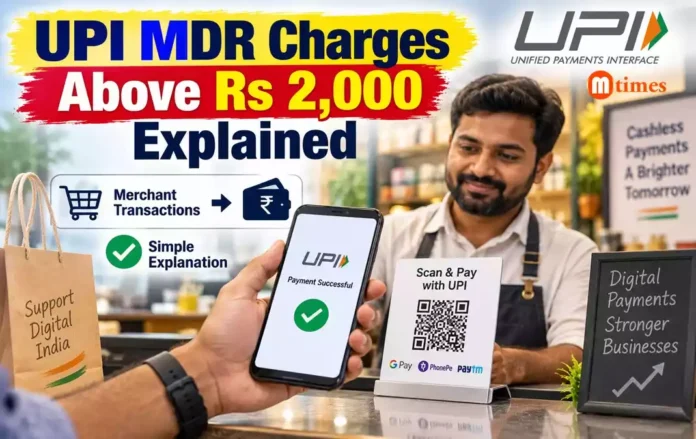

- A 0.4% MDR applies to specified merchant UPI transactions above ₹2,000 under the revised framework.
- Customers are not supposed to pay the MDR, as it is a charge within the merchant payment ecosystem.
- Person-to-person UPI payments and person-to-merchant payments up to ₹2,000 remain free.
Bhubaneswar: The revised UPI MDR charges framework introduces charges for certain higher-value merchant transactions, including a 0.4% merchant discount rate for specified payments above ₹2,000.
However, customers will not have to pay the MDR, according to the government. The charge operates within the merchant payment ecosystem, while everyday person-to-person UPI payments and most smaller merchant transactions continue to remain free.
What Is MDR in UPI Payments?
MDR, or Merchant Discount Rate, is a charge within the payment ecosystem associated with merchant transactions. It is not a direct fee imposed on customers for making UPI payments.
Banks have been advised to ensure that merchants do not pass the MDR on to customers. UPI application providers have also been prohibited from imposing platform fees or hidden charges on these transactions.
The government expects around 96% of merchant UPI transactions to remain unaffected by the revised framework.
Which UPI Transactions Will Attract MDR?
The revised framework primarily applies to specified merchant transactions above ₹2,000.
For eligible transactions outside categories with fixed charges, the MDR can be 0.4%, subject to the applicable category rules.
The government said MDR will apply to around 4% of merchant UPI transactions, while approximately 96% will remain unaffected.
UPI Payments That Remain Free
Several types of UPI transactions will continue to have zero MDR:
- All person-to-person UPI payments, regardless of transaction value.
- Person-to-merchant UPI payments up to ₹2,000.
- UPI QR payments received by small merchants under the P2PM category, up to ₹1 lakh per month.
This means ordinary UPI transfers between individuals will continue without an MDR charge.
Railway Ticket Payments Above ₹2,000
Railway ticket transactions above ₹2,000 fall under specified categories where a flat ₹5 MDR applies instead of the standard 0.4% rate.
The charge remains within the payment ecosystem and is not intended to be passed on to the customer.
Fuel Payments Above ₹2,000
For specified fuel payments above ₹2,000, the revised framework provides for a flat ₹5 MDR.
Fuel payments up to ₹2,000 will continue to have zero MDR.
The fixed charge means the MDR does not rise proportionately with the value of higher-value fuel transactions.
Insurance Premium Payments Above ₹2,000
Insurance premium payments above ₹2,000 under the specified category will also attract a flat ₹5 MDR instead of the standard 0.4% rate.
The ₹5 amount is a payment-ecosystem charge. It does not mean that policyholders will have to pay an additional ₹5.
Utility Payments Above ₹2,000
Specified utility payments above ₹2,000 will attract a flat ₹5 MDR under the revised framework.
Utility payments up to ₹2,000 will continue to have zero MDR.
As with other categories, the MDR is not supposed to be transferred to the customer.
What Happens to UPI Education Payments?
Educational fee collections above ₹2,000 fall under designated categories with flat-fee structures or capped processing rates rather than necessarily attracting the standard 0.4% MDR.
The designated Industry Program category covers transactions such as school tuition, university term fees and institutional entrance examinations, according to the government.
Educational transactions up to ₹2,000 will remain free of MDR. Higher-value payments will be subject to structures intended to avoid large percentage-based charges.
UPI MDR Charges: Key Transaction Rules
| UPI Transaction | Applicable MDR |
|---|---|
| Person-to-person UPI | Free |
| Merchant payment up to ₹2,000 | Free |
| Fuel above ₹2,000 | Flat ₹5 |
| Railway transactions above ₹2,000 | Flat ₹5 |
| Insurance premium above ₹2,000 | Flat ₹5 |
| Utility bills above ₹2,000 | Flat ₹5 |
| Small merchants under P2PM up to ₹1 lakh/month | Zero MDR |
| Other specified merchant transactions above ₹2,000 | 0.4%, subject to category rules |
Why Has the UPI MDR Framework Been Introduced?
The government said the changes are aimed at supporting the long-term sustainability of UPI while keeping person-to-person payments free and protecting small merchants.
Revenue generated from larger merchant transactions is expected to support banks, payment service providers and UPI application providers.
The government also expects this revenue to help expand and improve digital payment infrastructure, including services in rural and semi-urban areas.
Framework Includes Consumer Safeguards
The revised framework was introduced under the Payment and Settlement Systems Act, 2007, following deliberations by the UPI Steering Committee on applicable rates, operational arrangements and consumer safeguards.
The framework therefore separates the charges applicable within the merchant payment ecosystem from the experience of customers making UPI payments.
Will Customers Have to Pay UPI MDR?
No. The government has stated that MDR is not a direct customer fee.
Banks have been advised to prevent merchants from passing the charge to customers, while UPI application providers cannot impose platform fees or hidden charges in connection with the framework.
For consumers, person-to-person UPI payments remain free, while person-to-merchant payments up to ₹2,000 also continue without MDR.
New UPI Charges
The revised UPI MDR charges framework mainly affects a relatively small share of higher-value merchant transactions and specified sectors.
The government estimates that around 4% of merchant UPI transactions will be subject to MDR, leaving approximately 96% unaffected. The stated objective is to create a more sustainable payment ecosystem without introducing a direct MDR burden on everyday UPI users.
You May Like
Trending Searches Today |
- Odisha Plans New ABADHA-Like Scheme for Puri Development
- IMD Thunderstorm Alert: 25 Odisha Districts on Watch
- BJD Says It Maintains Distance From BJP and Congress, Not Part of INDIA Bloc
- Puri Records 36.6°C as Heat and Humidity Persist, Coastal Odisha To Face Intense Heat
- West Bengal to Recruit 14,454 Government Post, To Provide Rs 50,000 For Unmarried Women
Amazon Online Shopping