
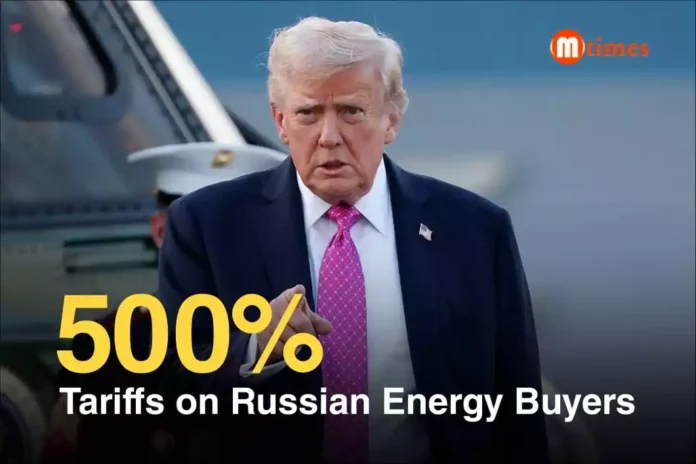


New Delhi: A proposed bill in the US Congress that seeks to impose sweeping tariffs and secondary sanctions of up to 500% on countries purchasing Russian energy could place India and China directly in Washington’s line of fire, after US President Donald Trump appeared to endorse the long-stalled legislation. The proposal represents a sharp escalation in economic pressure aimed at Moscow and could have far-reaching consequences for global trade, energy markets, and US relations with key partners. The US sanctions on Russian energy imports are being positioned as a decisive move to curb funding for Russia’s war effort in Ukraine.
The development follows remarks by Republican Senator Lindsey Graham, who said he met Trump at the White House on Wednesday, where the president approved the Russia-focused sanctions package. According to Graham, the bill could be brought to a Senate vote as early as next week, although its passage is not guaranteed.
US Sanctions on Russian Energy Imports: Bill Gains Momentum
“This is the right moment,” Senator Graham said in a statement, adding that Ukraine is making compromises in pursuit of peace while Russian President Vladimir Putin continues military operations. The legislation, titled the Sanctioning Russia Act of 2025, has been introduced by Graham alongside Democratic Senator Richard Blumenthal, making it a rare bipartisan effort amid deep political divisions in Washington.
The bill would authorise the United States to impose severe tariffs and secondary sanctions on countries that continue importing Russian oil, gas, uranium, and other key exports. India and China, which have emerged as the largest buyers of discounted Russian crude since the start of the Ukraine war, are explicitly named among the countries that could be affected.
The proposal has garnered dozens of co-sponsors in the Senate and is mirrored by a companion bill in the House of Representatives, signalling growing political appetite to tighten economic pressure on Russia.
US Sanctions on Russian Energy Imports and 500% Tariff Threat
Supporters of the legislation argue that Russia’s energy revenues have remained resilient despite previous Western sanctions and continue to fund Moscow’s military campaign. To counter this, the bill mandates tariffs of at least 500% on all Russian goods and services imported into the United States. Crucially, the same punitive tariff level would apply to imports from countries that knowingly trade in Russian-origin uranium and petroleum products.
The bill also directs the US Treasury Department to impose asset-blocking sanctions on financial institutions established under Russian law and owned fully or partially by the Russian state. Financial entities that transact with these institutions would also face penalties. In addition, the US Commerce Department would be required to ban the export or transfer of US-produced energy and energy-related products to or within Russia.
A White House official has confirmed that President Trump supports the sanctions legislation. While the administration had previously sought revisions to provide the president with greater flexibility in enforcing the measures, it remains unclear whether those changes have been incorporated.
India’s Russian Oil Imports Under Scrutiny
India has dramatically increased its intake of discounted Russian crude since the outbreak of the Ukraine conflict, transforming Russia into one of its top oil suppliers. At certain points, Russian oil accounted for nearly 35–40% of India’s total crude imports, compared with just 0.2% before the war. New Delhi has defended the purchases as essential for ensuring energy security and protecting domestic consumers from global price volatility.
Also Read | Trump Completely Messed Up India US Ties, Says Indian-American Congressman as Strategic Relations Slide
President Trump has repeatedly criticised India’s stance. In August, his administration imposed an additional 25% levy on Indian imports, raising total US tariffs on Indian goods to 50% — among the highest applied to any major trading partner. Despite US sanctions on major Russian oil producers Rosneft and Lukoil, Russian crude continues to reach India, though volumes have moderated.
According to commodity analytics firm Kpler, India imported roughly 1.2 million barrels per day of Russian crude in December 2025, the lowest level since December 2022. Supplies have largely been maintained by private refiners that have adjusted sourcing strategies to navigate sanctions.
Trade Risks for India, China and the Global Economy
Under the proposed legislation, countries found to be knowingly importing Russian petroleum products could face tariffs of up to 500% on their exports to the United States. For India, this could expose exporters to severe trade disruptions at a time when New Delhi is seeking to expand shipments of pharmaceuticals, information technology services, and textiles to the US market.
China, meanwhile, could face even broader fallout. A 500% tariff on Chinese goods which form a significant share of US consumer imports could fuel inflation, disrupt already fragile global supply chains, and increase the risk of job losses within the United States itself.
Any move by Washington to enforce such secondary sanctions could further strain India–US relations, which have otherwise deepened across defence, trade, and strategic cooperation. However, ties have already faced turbulence in 2025, with trade disputes, immigration curbs, and geopolitical tensions testing the relationship in ways not seen for decades.
As the two largest buyers of discounted Russian crude, India and China remain central to Russia’s economic resilience. Their continued purchases have provided Moscow with a critical financial lifeline, even as Western sanctions intensify making them key targets if the proposed US legislation becomes law.
You May Like
Trending Searches Today |
- April 6, 2026 Daily Horoscope: Growth, Caution, and Emotional Clarity
- National Maritime Day India: PM Modi Highlights Sector’s Role in Growth
- Mukhyamantri Annapurna Yojana Odisha: Free Rice 5kg for All Beneficiary
- BJP West Bengal CM Face: Party Bets on Modi Over Leadership Pick
- Bhuvneshwar Kumar Nears 200 IPL Wickets Before CSK Clash
Amazon Online Shopping