
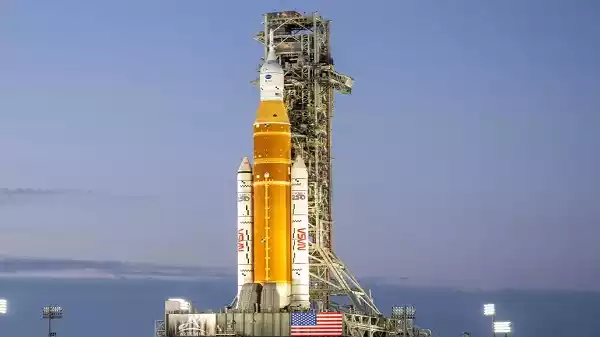


- Artemis II will carry four astronauts on a 10-day journey around the Moon.
- The mission marks NASA’s first crewed lunar flight since Apollo 17 in 1972.
- Artemis II will pave the way for a human lunar landing under Artemis III in 2027.
New Delhi: The Artemis II Moon mission is set to mark a historic return of humans to lunar space, as NASA prepares to launch a four-member crew on February 6. The mission comes more than five decades after the Apollo 17 mission in December 1972, the last time humans travelled to the Moon.
NASA has already moved the Orion spacecraft and the Space Launch System (SLS) rocket to the launch pad at Cape Canaveral, signalling final preparations for the landmark flight.
Meet the Artemis II Crew
The Artemis II crew will be led by commander Reid Wiseman, with Victor Glover serving as pilot. Mission specialists include Christina Koch and Jeremy Hansen of the Canadian Space Agency.
This will be the first time a Canadian astronaut travels to the Moon.
Testing Orion in Deep Space
Artemis II is a 10-day mission designed to rigorously test NASA’s deep-space systems in real flight conditions. While the spacecraft will not land on the lunar surface, it will orbit the Moon and travel more than 230,000 miles from Earth at its farthest point.
Following launch from Kennedy Space Center, the crew will complete initial Earth orbits to assess life support, navigation, and other critical onboard systems.
Gravity-Assisted Journey Around the Moon
After system checks, the astronauts will perform a trans-lunar injection burn using the Moon’s gravity to slingshot Orion toward and around the far side of the Moon. The spacecraft will trace a figure-eight trajectory before beginning its return to Earth.
The mission follows a free-return path, allowing Orion to coast back without additional engine burns if required—an important safety feature for deep-space travel.
Preparing for a Permanent Lunar Presence
NASA Administrator Jared Isaacman described Artemis II as a “momentous step forward for human spaceflight,” adding that it will send humans farther from Earth than ever before and provide critical data for future missions.
Also Read | India Successfully Tests MPATGM Missile, Boosting Indigenous Anti-Tank Defence Capability
Artemis II will set the stage for Artemis III, planned for 2027, which aims to land astronauts on the Moon’s South Pole and establish a long-term human presence.
Final Tests Before Launch Artemis II Moon mission
NASA said engineers are now preparing the rocket for a wet dress rehearsal, a full test of fueling operations and countdown procedures. The mission builds on the success of Artemis I, which flew successfully in August 2022.
Under the Artemis programme, NASA aims to unlock scientific discoveries, stimulate economic growth, and prepare for future crewed missions to Mars—ushering in a new era of human exploration beyond Earth.
You May Like
Trending Searches Today |
- Odisha Weather Live Updates: Bay of Bengal Low Pressure May Intensify Into Deep Depression
- CM Majhi Orders Return of Odia Tourists’ Mortal Remains In MP Car Accident
- Odisha Devotees MP Car Accident: PM Modi Announces ₹2 Lakh Aid for Each Deceased Victim
- Seven From Odisha Family Killed After Car Swept Into Drain in Madhya Pradesh
- Ekamra Residency: BDA Opens Online Applications for 496 Apartments
Amazon Online Shopping