
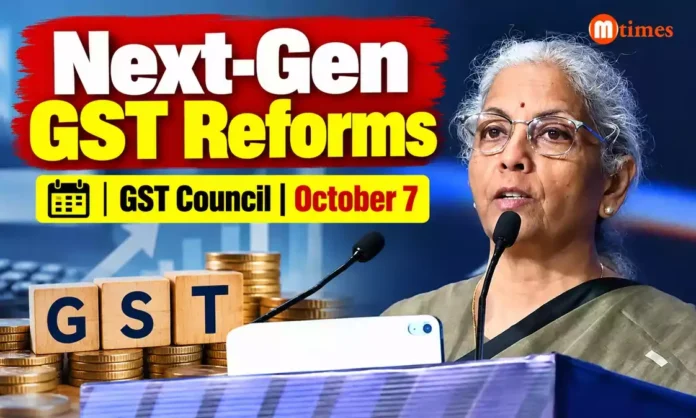

- The next phase of GST reforms will target registration, returns, refunds, disputes and input tax credit.
- Proposals are scheduled to come before the GST Council on October 7.
- Gross GST collections reached ₹12.46 lakh crore during April-September 2026, up 11.6% year-on-year.
New Delhi: The next phase of Next-Gen GST reforms will focus on simplifying registration, returns, refunds, disputes and input tax credit, Union Finance Minister Nirmala Sitharaman said on Monday. The proposals are scheduled to be placed before the GST Council on October 7.
In an article titled “Next-Gen GST and India’s Next Phase of Growth,” Sitharaman said the reform programme has two linked objectives: rationalising tax rates and making GST compliance easier. The rate changes took effect on September 22, 2025, while the proposed process reforms are aimed at reducing the time and cost involved in meeting tax obligations.
GST Reforms Aim to Simplify Compliance
The Prime Minister’s Office said on X that Next-Gen GST reforms were making taxation simpler and more predictable for businesses and households.
According to the PMO, easier compliance and an improved refund process could provide businesses with greater confidence to invest and expand, supporting the broader objective of building a Viksit Bharat.
Sitharaman said the performance following the GST rate changes provided grounds for confidence. The value of reported taxable supplies increased by 25.8% between October 2025 and July 2026 compared with the corresponding period a year earlier.
The Finance Minister said the lighter rate structure had been accompanied by an expansion in reported economic activity.
GST Collections Rise 11.6%
Gross GST collections reached ₹12.46 lakh crore during April to September 2026, registering an 11.6% increase over the corresponding period of the previous year.
The Finance Minister said GST collections recorded double-digit year-on-year growth in every month from June through September. Collections during these four months grew by nearly 15%.
Net GST collections, after accounting for refunds, increased by 10.4% during the first half of the financial year.
Sitharaman said the growth indicated that taxpayer relief had taken place alongside an increase in resources available for development.
Taxable Supplies Grow Across Sectors
The increase in reported taxable supplies was spread across all 11 sector groups and all major states, according to the Finance Minister.
Reported business-to-consumer sales increased by 26.7% in the post-reform comparison.
Sitharaman said lower taxes reflected in prices could give households greater flexibility to spend on other needs or save. The benefits could also flow through retailers, suppliers and producers as demand moves across the economy.
GST to Support Small Businesses
Sitharaman highlighted the importance of a common national market for small and medium enterprises.
She said businesses in Tier-2 and Tier-3 towns should be able to reach customers outside their immediate markets while continuing to invest and create employment locally.
Businesses expanding into smaller towns could also generate opportunities for local suppliers and distributors. According to the Finance Minister, the common GST framework supports these connections, while simpler administration could make them easier to maintain.
GST registrations across Central and state jurisdictions stood at approximately 1.71 crore at the end of August, nearly 15% higher than a year earlier.
For the April to July 2026 tax periods, GSTR-3B returns filed by their due dates were 12.6% higher than during the corresponding period of the previous year.
Focus on Input Tax Credit and Refunds
The next phase of reforms will also address input tax credit.
Sitharaman said post-reform figures showed an increase in the share of tax liability discharged through credits, while accumulated credit declined relative to taxable supplies.
She stressed that effective use of eligible input tax credit was particularly important for smaller businesses because working capital affects their ability to purchase inputs, fulfil orders and take on additional business.
Approximately ₹1.80 lakh crore was refunded during April to September 2026.
The Finance Minister said timely return of amounts due to businesses was an essential part of a functioning tax system. Greater predictability in refunds, she added, could help businesses plan purchases and production with greater confidence.
States’ GST Revenue Also Increases
States’ aggregate State GST receipts, including their share of Integrated GST settlements, increased by about 16% during the six-month period.
Sitharaman said these revenues support infrastructure and public services, which in turn improve conditions for households and businesses.
The proposed process reforms are now set to move to the GST Council, where registration, returns, refunds, disputes and input tax credit are expected to be among the key areas under consideration.
You May Like
Trending Searches Today |
- Sensex, Nifty Recover as FMCG, Energy and Banks Lead Gains
- Odisha CM Launches Jeevan Jindabad 2.0 Campaign, Addiction-Free Odisha
- Next-Gen GST Reforms to Focus on Registration, Refunds and ITC: FM
- Odisha Student Union Elections to Be Held on October 15 After 8 Years
- Raj, Uddhav Thackeray Lead Mumbai Garjana Morcha; Targets Election Commission
Amazon Online Shopping