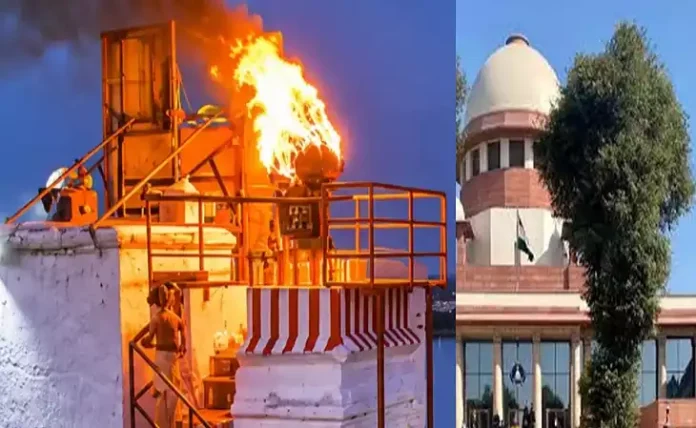

- The Supreme Court directed that the Karthigai Deepam be lit at the Deepathoon on November 28.
- Senior Tamil Nadu officials and temple authorities have been asked to explain the alleged non-compliance and appear on December 15.
- The CRPF will secure both the temple and Dargah, while the temple’s Board of Trustees has been suspended and former High Court judges appointed as receivers.
New Delhi, November 28, 2026:The Supreme Court has directed that the ceremonial Karthigai Deepam lamp be lit at the Deepathoon on Thiruparankundram Hill in Madurai on Saturday, November 28, after expressing serious concern over the alleged non-compliance with its earlier order by Tamil Nadu authorities.
A Bench comprising Justices Aravind Kumar and Vipul Pancholi issued contempt show-cause notices to senior state officials and members of the temple administration, observing that there appeared to be a prima facie violation of its November 20 interim order.
The court also suspended the Board of Trustees of the Arulmigu Subramaniaswamy Temple and appointed two former Madras High Court judges as receivers to oversee the temple’s administration and implementation of its directions.
Supreme Court Directs Deepathoon Lamp Lighting on November 28
The court directed that the ceremonial lamp be lit at the Deepathoon using the flame from the lamp previously lit at the Uchipillaiyar Mandapam, provided it was still burning. If the flame was unavailable, alternative arrangements could be made.
The November 20 interim order had permitted the lighting of the lamp at the Deepathoon as a one-time measure. However, on November 24, the lamp was lit at the Uchipillaiyar Mandapam instead of the disputed stone pillar.
The temple’s Board of Trustees subsequently passed a resolution stating that the lamp could be lit only at the customary location, citing established temple traditions. The Madurai District Collector relied on the resolution while explaining why the earlier direction had not been implemented.
The Supreme Court took serious exception to this position and issued fresh directions.
Every Devotee Allowed to Light Lamps With Restrictions
Modifying its earlier arrangement, the Supreme Court permitted every devotee to participate in lighting lamps at the Deepathoon.
However, the court imposed a specific geographical safeguard. The lighting activity must take place at least 50 metres away from the Sikandar Dargah on all sides.
The court also directed the Central Reserve Police Force (CRPF) to provide security to both the temple and the Dargah. It emphasised that Muslim devotees must not be prevented from accessing the Dargah or offering prayers there.
These directions seek to ensure the implementation of the court’s order while maintaining security and protecting access to the neighbouring religious site.
Contempt Notices to Tamil Nadu Chief Secretary, DGP and Collector
The Supreme Court issued show-cause notices to senior government officials and temple authorities, asking them to explain why contempt proceedings should not be initiated over the alleged violation of its November 20 order.
Those named in the notices include Tamil Nadu Chief Secretary Dr M Sai Kumar, Director General of Police Dr Mahesh Agarwala, HR&CE Department Secretary V Rajaram, HR&CE Commissioner TG Vinay, Madurai District Collector Nishant Krishna and Madurai Superintendent of Police L Devanathan.
The notices also cover other HR&CE officials and members of the temple administration, including its Executive Officer and Board of Trustees.
The court directed the concerned officials and trustees to remain personally present on December 15.
Importantly, the notices seek explanations at this stage. They do not amount to a final finding of contempt against the individuals concerned.
Supreme Court Questions Administrative Conduct
The Bench expressed concern over the handling of its earlier direction and observed that there appeared to be “prima facie administrative chaos” in Tamil Nadu, at least in Madurai district.
It also questioned whether executive authorities had acted under the influence of political leadership and said the sequence of events needed to be examined.
The court rejected the preliminary status report submitted by the Madurai District Collector and directed the Tamil Nadu Chief Secretary to file an affidavit explaining the entire sequence of events.
The affidavit is expected to include relevant communications, emails and other details concerning the implementation of the November 20 order.
Referring to Article 144 of the Constitution, the Bench reiterated that all civil and judicial authorities in India must act in aid of the Supreme Court.
It stressed that judicial orders are binding on authorities unless modified or set aside by the court itself.
Temple Board Suspended, Former Judges Appointed as Receivers
In another significant direction, the Supreme Court suspended the Board of Trustees of the Arulmigu Subramaniaswamy Temple.
The Bench appointed former Madras High Court judges Justice S Vaidyanathan and Justice V Parthiban as receivers to take charge of the temple’s administration and ensure compliance with the court’s directions.
The court also vacated its earlier stay on the Madras High Court’s findings concerning the Deepathoon. However, it clarified that the safeguards previously imposed to protect the Sikandar Dargah would continue to remain in force.
Background of the Thiruparankundram Karthigai Deepam Dispute
The dispute concerns the traditional lighting of the Karthigai Deepam at the Deepathoon, a stone pillar situated on Thiruparankundram Hill near the Sikandar Dargah in Madurai.
The issue reached the Supreme Court after proceedings before the Madras High Court concerning the location and permission for lighting the ceremonial lamp.
On November 20, the Supreme Court permitted the lamp to be lit at the Deepathoon as a one-time measure, subject to safeguards. The subsequent failure to implement that direction led to contempt petitions and the latest order on November 27.
The Supreme Court’s November 28 direction is a significant development in the dispute. The underlying legal questions concerning the site and the competing claims remain subject to judicial proceedings.
You May Like