
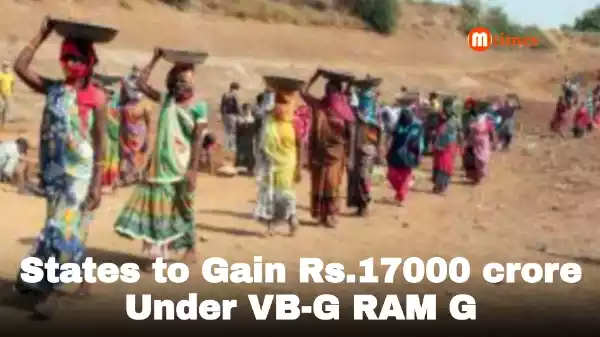


New Delhi: States are expected to receive nearly ₹17,000 crore more in fund allocations compared to the average distribution of the past seven years under the newly proposed VB-G RAM G funding framework, according to a research report released by the State Bank of India (SBI).
The report explains that fund-sharing between the Centre and states under the new model will be guided by a normative assessment approach, rather than historical allocations. Based on a simulated scenario focusing solely on the Centre’s share, the study estimates significant fiscal gains for states when compared with average allocations during the last seven financial years.
According to the analysis, the simulated framework applies seven key attributes divided across two foundational pillars—equity and efficiency. This structure is designed to ensure a fair and performance-oriented distribution of funds.
Centre-State Fund Sharing Framework Could Boost State Allocations
Soumya Kanti Ghosh, Group Chief Economic Advisor at SBI, stated that the analysis indicates a clear advantage for states under the proposed framework. He noted that states could collectively gain around ₹17,000 crore when benchmarked against the average allocation of the previous seven years, assuming the hypothetical weights and inter-state distribution applied in the model.
The report clarified that the simulation was conducted using a normative assessment limited to the Centre’s portion of funding. The objective was to design a balanced approach that addresses both fairness and performance outcomes in fund distribution.
Two-Pillar Model Focuses on Equity and Efficiency
The proposed allocation framework is built around two core principles. The first pillar—equity—aims to ensure that states with higher structural challenges, a larger rural workforce, greater administrative spread, and stronger dependence on employment schemes receive sufficient fiscal support to meet labour demand.
Also Read | Congress to Launch ‘Save MNREGA’ Campaign from January 5 After CWC Meet
The second pillar efficiency seeks to reward states that demonstrate effective utilisation of funds. This includes the ability to generate sustained employment, create durable assets, and ensure timely wage disbursements. The report stated that a total of seven criteria were identified and categorized under these two pillars to evaluate performance.
Centre-State Fund Sharing Framework Shows Most States as Net Gainers
The SBI report noted that the difference between allocations determined through normative assessment and the average allocations under MGNREGA from FY19 to FY25—excluding the pandemic-affected FY21 was used to calculate gains or losses.
Overall, the analysis shows that states would collectively gain around ₹17,000 crore under the hypothetical framework, making them net beneficiaries. Based on the assumed weightage and inter-se distribution, all states emerge as gainers except two, which experience only marginal reductions.
In the case of Tamil Nadu, the report highlighted that if FY24 is treated as an outlier year—when allocations increased by 29 per cent compared to the average of FY22 and FY23—the projected loss becomes almost insignificant.
The report further identified Uttar Pradesh and Maharashtra as the biggest beneficiaries under the model, followed by Bihar, Chhattisgarh, and Gujarat.
Concluding the analysis, SBI emphasised that adopting objective, transparent criteria for fund allocation could strengthen fiscal devolution for both developed and economically lagging states. The report added that outcomes could be further improved if states effectively leverage their mandatory 40 per cent contribution under the scheme.
You May Like
Trending Searches Today |
- Indian Stock Market Fall Today as Sensex Drops Over 700 Points
- Bhubaneswar Foundation Day 2026 Celebrated with Lights and Cultural Events
- April 13, 2026 Daily Horoscope Predicts Balance Between Emotions and Finances
- India Rejects China Renaming Arunachal as ‘Fictitious’ Claim
- US Blockade Strait of Hormuz Announced After Failed Iran Talks: President Trump
Amazon Online Shopping