
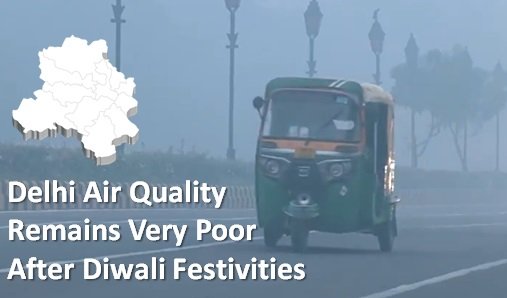

The air quality in several parts of Delhi remained in the “very poor” category on Tuesday morning, a day after Diwali celebrations filled the skies with smoke and particulate matter. According to the Central Pollution Control Board’s (CPCB) Sameer application, the average Air Quality Index (AQI) at 7.05 am stood at 350, placing it firmly in the “very poor” range. Some areas, however, slipped into the “severe” category, raising concerns over the capital’s worsening air pollution levels.
Delhi AQI Touches Severe Levels in Multiple Areas
Data from the CPCB revealed that pollution levels in localities such as Bawana (AQI 423), Jahangirpuri (AQI 407), and Wazirpur (AQI 408) had reached “severe” levels. The AQI scale categorizes air quality from “good” (0–50) to “severe plus” (above 450). A reading between 301 and 400 indicates “very poor” air, while 401 to 450 means “severe” pollution. These high readings highlight the continued struggle Delhi faces with smog and toxic air, especially following festive celebrations that typically involve widespread firecracker use.
Multiple Factors Contribute to Deteriorating Air Quality in Delhi
Delhi’s air quality tends to worsen in the winter months due to a combination of meteorological and human factors. Stubble burning in the neighboring states of Punjab and Haryana, along with falling temperatures and reduced wind speeds, prevent pollutants from dispersing. Emissions from vehicles, coal-fired power plants, and industrial activities further add to the pollution load. This recurring pattern has made Delhi one of the world’s most polluted capitals.
On October 15, the Supreme Court permitted the limited sale and use of green firecrackers in the Delhi-NCR region under strict conditions. Sales were allowed between October 18 and October 21 at designated locations, and their use was restricted to between 6 am and 7 am and again from 8 pm to 10 pm. Green firecrackers are marketed as less polluting alternatives since they exclude harmful elements such as lithium, arsenic, barium, and lead.
Most Monitoring Stations Record Very Poor or Severe Air Quality
According to PTI, 36 out of Delhi’s 38 air quality monitoring stations reported pollution levels in the “red zone,” meaning “very poor” to “severe” air quality. At 10 pm on Monday, Delhi’s overall AQI was recorded at 344. Several key areas, including Dwarka (417), Ashok Vihar (404), Wazirpur (423), and Anand Vihar (404), remained in the “severe” category.
In response to the worsening conditions, the Commission for Air Quality Management (CAQM) had already implemented Stage 2 restrictions under the Graded Response Action Plan (GRAP) on Sunday to curb pollution in Delhi and the adjoining NCR areas. These restrictions include limits on construction activities, enhanced pollution monitoring, and the promotion of cleaner fuel usage.
Authorities Urge Caution as Air Quality Declines
Authorities have urged residents to limit outdoor activities, especially during early mornings and late evenings when pollutant concentration peaks. They also advise wearing protective masks and using air purifiers indoors. With the AQI likely to fluctuate between “very poor” and “severe” in the coming days, experts suggest that stronger enforcement of pollution control measures and reduced emissions from local sources are crucial to improving air quality.
Get Latest News Live on MTIMES along with Breaking News and Top Headlines, Political News and around The World.
You May Like
Trending Searches Today |
Odisha SSB Lecturers Protest for UGC Pay Parity and Service Recognition
Donald Trump’s 100% Tariffs on Indian Pharma Exports to US Spark Market Concerns
BSNL 4G Services at ₹1: Apply Now Free 30-Day Offer Diwali Bonanza Plan
Indian Army and BSF Personnel Celebrated Diwali Along Border Areas
Thamma Box Office: Ayushmann Khurrana’s Biggest Opener Set to Break Records
PM Modi Highlights Role of AI in Unlocking India’s Ancient Manuscripts