
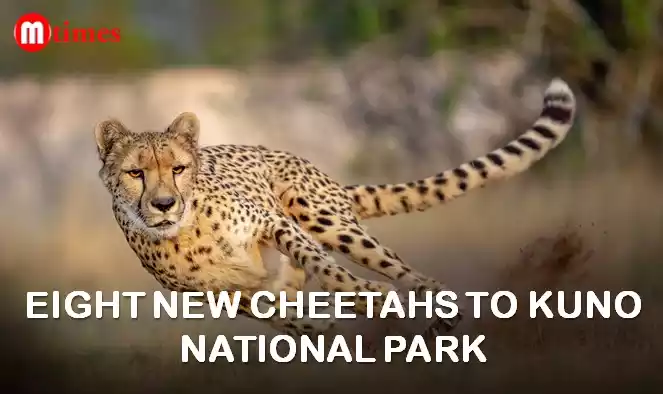

- Eight cheetahs from Botswana will arrive at Kuno National Park on February 28
- India’s total cheetah population will rise to 46 under Project Cheetah
- Authorities are spreading cheetahs across habitats to reduce disease risk
India’s ambitious wildlife restoration effort takes another major step on February 28 as eight cheetahs to Kuno National Park arrive from Botswana, pushing the country’s cheetah population to 46. The move marks the third intercontinental translocation under Project Cheetah and signals renewed momentum after early challenges in the programme.
The consignment includes six females and two males, strengthening genetic diversity at the Madhya Pradesh reserve.
How the Botswana cheetahs will reach Kuno
The cheetahs will be flown from Botswana to Gwalior aboard an Indian Air Force aircraft, with landing expected between 9 pm and 10 pm on Friday. From there, helicopters will transport the animals to Kuno National Park, where they are scheduled to arrive Saturday morning.
Project officials say the entire journey will take close to 10 hours, with veterinary teams monitoring the animals throughout transit.
Why this transfer matters for Project Cheetah
According to Project Cheetah Director Uttam Sharma, the new arrivals will remain in quarantine for about a month before gradual acclimatisation. The controlled approach is aimed at reducing stress and preventing disease outbreaks.
This phase is critical. Wildlife experts have stressed that expanding numbers alone is not enough; survival, breeding success, and habitat management will determine whether cheetahs can once again thrive in India.
India avoids single habitat risk after early losses
Authorities have deliberately avoided concentrating all cheetahs in one location. While Kuno remains the core site, three cheetahs have already been shifted to Gandhi Sagar Wildlife Sanctuary to spread risk.
This strategy follows lessons from previous years, when disease and environmental stress led to cheetah deaths and cub mortality. Officials say diversification of habitats is now central to long term planning.
Breeding progress offers cautious optimism
Despite setbacks, breeding success has offered encouragement. Since 2023, 39 cubs have been born at Kuno, with 27 surviving. Earlier this month alone, eight cubs were born in two litters.
Cheetahs such as Jwala, Aasha, Gamini, Veera, Nirva, and India born Mukhi have all produced offspring, demonstrating that adaptation to Indian conditions is possible.
From extinction to revival after 70 years
The cheetah, the world’s fastest land animal, vanished from India nearly seven decades ago due to hunting and habitat loss. Project Cheetah aims not just to reintroduce the species but to rebuild a self sustaining population across multiple landscapes.
With the Botswana batch, officials say the next target is reaching a stable population of 50 cheetahs, after which focus will shift toward expansion beyond Madhya Pradesh.
The arrival of eight cheetahs to Kuno National Park is more than a numerical boost. It reflects a recalibrated conservation strategy that blends global cooperation, scientific caution, and long term ecological planning. Whether India can turn reintroduction into true revival now depends on what happens after the gates of quarantine open.
Like this content? Sign up for our daily newsletter to get latest updates. or Join Our WhatsApp Channel
You May Like
Trending Searches Today |
- Ai+ PulseTab Price India Set at Rs 9,999 with Big Display and Battery
- Mamata Banerjee UCC Opposition Sharpens Political Battle in West Bengal
- CAA Citizenship West Bengal: Modi Promises Fast Track for Refugees
- Koraput Bus Accident OSRTC Volvo Falls 40 Feet at Sunki Ghati, 1 Dead
- April 11, 2026 Daily Horoscope Predicts Emotional Balance and Financial Awareness
Amazon Online Shopping