
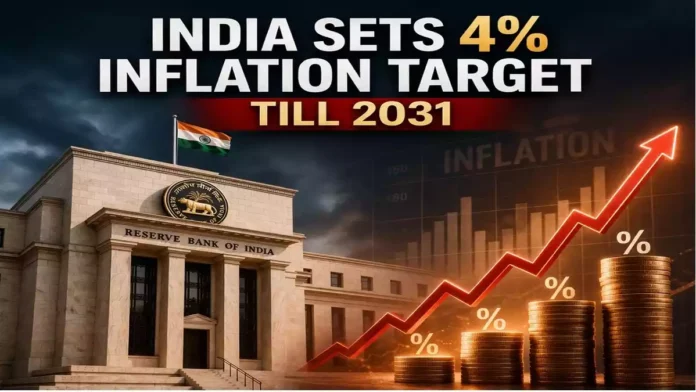

- India retains 4% inflation target for 2026–2031 period
- RBI to operate within 2%–6% tolerance band
- Move signals policy stability and investor confidence
New Delhi: India has reaffirmed its India inflation target 4 percent for the next five years, sending a strong signal of continuity in monetary policy. The Finance Ministry’s latest notification locks in this benchmark from April 2026 to March 2031, keeping the same 2 percent to 6 percent tolerance band. The decision matters not just for policymakers but for borrowers, investors, and traders tracking interest rates and inflation trends.
This step reinforces India’s commitment to price stability at a time when global inflation pressures are easing but risks remain unpredictable.
Why India Kept Inflation Target Unchanged
The government’s decision reflects confidence in the current inflation-targeting system introduced in 2016. Over the past decade, this framework has helped anchor inflation expectations and guide interest rate decisions.
Officials believe changing the target now could disrupt market confidence. Stability in policy helps investors make long-term decisions and reduces uncertainty in financial markets.
The Reserve Bank of India continues to play the central role. Its Monetary Policy Committee adjusts repo rates and liquidity to ensure inflation stays near 4 percent, while still supporting economic growth.
As per the official notification, the framework remains legally backed under the RBI Act.
India Inflation Target 4 Percent and Economic Impact
Keeping the target unchanged has several direct implications:
First, it signals predictability. Businesses and global investors prefer stable policy environments, especially in emerging markets like India.
Second, it balances growth and inflation. A lower target could slow growth, while a higher one risks eroding purchasing power. The 4 percent mark is seen as a middle path.
Third, it supports financial market stability. Bond yields, lending rates, and currency movements often respond to inflation expectations.
Challenges Ahead for RBI
Despite the stable target, maintaining inflation within the band will not be easy.
Global risks still exist. Geopolitical tensions, supply chain disruptions, and commodity price swings can quickly push inflation higher.
Also Read | LPG Aadhaar Authentication eKYC: Govt Clears Confusion, No Repeat Needed
Domestically, food inflation remains a key concern. Weather disruptions, especially erratic monsoons, can sharply impact prices.
The RBI has faced such challenges before, particularly during the pandemic period when inflation temporarily breached limits.
What This Means for Interest Rates and Markets
The unchanged target suggests that RBI policy will remain data-driven rather than aggressive.
If inflation stays near 4 percent, interest rates may remain stable or gradually ease. However, any spike beyond 6 percent could trigger tighter monetary policy.
For traders and investors, this means:
- Watch CPI inflation data closely
- Track RBI policy meetings for rate signals
- Expect gradual, not abrupt, policy shifts
Policy Continuity Sends Strong Signal
Economists widely see this move as a vote of confidence in India’s macroeconomic framework.
By sticking to the same inflation target, the government is prioritizing credibility over experimentation. This consistency is crucial as India positions itself as a stable, high-growth economy in an uncertain global environment.
Over the next five years, the focus will remain clear: keep inflation under control without derailing growth momentum.
You May Like
Trending Searches Today |
- Odisha Crime Rate 2025 Rises Despite Peaceful Claim
- India Inflation Target 4 Percent Set Till 2031
- March 26 2026 Daily Horoscope: Key Life Signals for Every Zodiac
- March 25 2026 Daily Horoscope: What the Stars Reveal Today
- Harish Rana Passive Euthanasia Death First Indian Case Ends at AIIMS
Amazon Online Shopping