
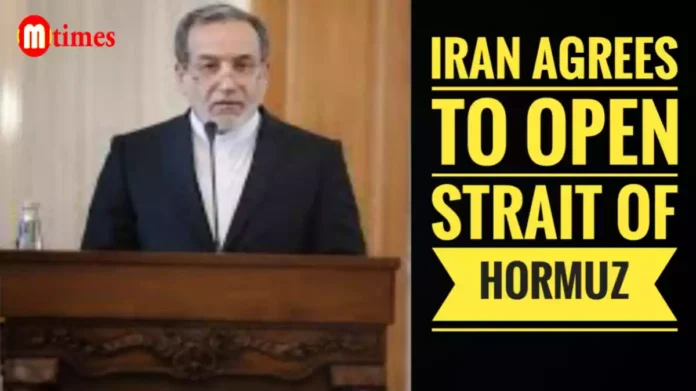

- Iran signals conditional ceasefire if attacks stop
- Strait of Hormuz opens for two weeks under strict coordination
- US pauses military strikes as negotiations gain momentum
Dubai: The Iran Strait of Hormuz ceasefire marks a critical pause in rising Middle East tensions, offering temporary relief to global oil markets and shipping routes. Iran has announced it will halt military actions if attacks against it stop, while allowing controlled maritime movement through one of the world’s most strategic waterways for two weeks.
This move comes as backchannel diplomacy between Iran and the United States shows signs of progress, raising cautious optimism about a broader de-escalation.
Iran Sets Conditions for Strait of Hormuz Ceasefire
Iran’s Foreign Minister Seyed Abbas Araghchi made it clear that the ceasefire is not unconditional. Tehran’s stance depends entirely on reciprocal restraint.
Iran’s leadership has stated that its armed forces will suspend defensive operations only if opposing military actions are halted. The decision reflects pressure to avoid further escalation while protecting national interests.
At the same time, Iran has temporarily reopened the Strait of Hormuz, a chokepoint responsible for nearly a fifth of global oil shipments. However, vessels must comply with strict coordination protocols set by Iranian authorities.
US Iran Talks Drive Strait of Hormuz Opening
The ceasefire window follows renewed diplomatic engagement between Washington and Tehran. The United States reportedly pushed a 15-point negotiation framework, while Iran responded with its own 10-point proposal.
Former US President Donald Trump confirmed that planned military strikes would be paused for two weeks, aligning with Iran’s conditions. He described the move as part of a “double-sided ceasefire,” indicating mutual concessions.
Also Read | Trump Cuba Next Statement NATO Criticism: US Signals Aggressive Shift in
Trump also suggested that key disagreements between both nations have largely been resolved, hinting at a possible long-term agreement.
Global Impact of Iran Strait of Hormuz Ceasefire
The temporary reopening of the Strait of Hormuz carries immediate global implications. Oil markets, which react sharply to instability in the Gulf region, may see short-term stabilization.
Shipping companies and energy traders are likely to resume operations cautiously during this two-week window. However, the conditional nature of the ceasefire keeps uncertainty high.
Any breakdown in talks could quickly reverse gains and trigger renewed disruptions in global supply chains.
What Happens After the Two Week Ceasefire Window
The next two weeks are crucial. Both Iran and the United States aim to finalize a broader agreement that could reshape regional stability.
If negotiations succeed, this could mark a turning point in long-standing tensions. If not, the region risks slipping back into confrontation.
For now, the ceasefire offers a narrow but significant opportunity to avoid a wider conflict and secure one of the world’s most vital energy corridors.
You May Like
Trending Searches Today |
- Iran Strait of Hormuz Ceasefire Opens 2 Week Window for Global Shipping
- Narasinghpur Custodial Death Case: Six Retired Police Arrested After 10 Years
- April 8, 2026 Daily Horoscope: Opportunities, Money, and Emotional Clarity
- April 7, 2026 Daily Horoscope: Emotional Shifts and Growth Opportunities
- April 6, 2026 Daily Horoscope: Growth, Caution, and Emotional Clarity
Amazon Online Shopping