
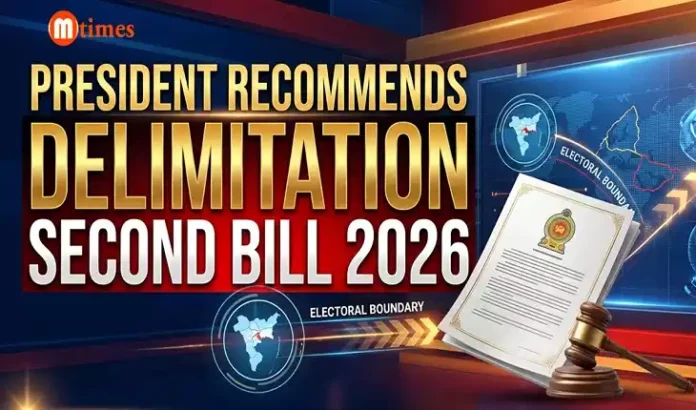

- Droupadi Murmu has recommended Lok Sabha consideration of the Delimitation (Second) Bill, 2026, under Article 117(3).
- The proposal seeks to increase Lok Sabha and state Assembly seats by 50 per cent while retaining the existing relative distribution among states.
- TThe Lok Sabha is scheduled to meet on November 30, with the delimitation proposal linked to the implementation of 33 per cent women’s reservation.
New Delhi, November 28, 2026: President Droupadi Murmu has recommended that the Lok Sabha consider the Delimitation (Second) Bill, 2026, ahead of the special sitting of Parliament scheduled for November 30.
According to a Lok Sabha bulletin issued on Saturday, the President made the recommendation under Article 117(3) of the Constitution. The development marks another step in the government’s efforts to advance its revised delimitation proposals.
The Union Cabinet approved the fresh legislation on Friday. The government is expected to take up the Bill during the upcoming special sitting of the Lok Sabha.
The recommendation is a procedural step and does not mean that the Bill has been passed by Parliament or has become law.
What Does the Delimitation (Second) Bill Propose?
The proposed legislation provides for a 50 per cent increase in the number of Lok Sabha seats allocated to every state and Union Territory, over and above the existing strength.
Under the proposal, the maximum strength of the Lok Sabha could increase to 850 members, comprising up to 815 representatives from states and 35 from Union Territories.
The Bill also proposes a 50 per cent increase in the total number of seats in state Legislative Assemblies and the Assemblies of Union Territories.
The government has proposed maintaining the existing relative distribution of Lok Sabha seats among states, addressing concerns that states with slower population growth could lose their share of parliamentary representation.
Existing Share of States Proposed to Be Protected Until 2051
One of the key features of the revised proposal is the plan to preserve the existing relative allocation of Lok Sabha seats among states until the relevant population figures from the first Census conducted after 2051 are published.
The proposed arrangement seeks to increase representation across the country without changing the existing inter-state ratio of parliamentary seats.
For redrawing the boundaries of individual constituencies, the government proposes using the 2011 Census figures.
The proposed framework therefore distinguishes between the allocation of seats among states and the redrawing of constituency boundaries within them.
Delimitation Bill Linked to Women’s Reservation
The fresh delimitation proposal is closely linked to the government’s plan to implement 33 per cent reservation for women in the Lok Sabha and state Legislative Assemblies.
The government has also cleared the Constitution (One Hundred and Thirty-Second Amendment) Bill, 2026, which seeks to provide the constitutional framework for implementing women’s reservation through the proposed delimitation exercise.
Under the proposed arrangement, seats would be reserved for women, including women belonging to Scheduled Castes and Scheduled Tribes. The allocation and rotation of reserved constituencies would be determined through the delimitation process.
The government has indicated its objective of implementing women’s reservation from the 2029 Lok Sabha elections. However, this will depend on Parliament passing the required legislation and completion of the subsequent constitutional and delimitation processes.
Why Has the Government Brought a Second Delimitation Bill?
The fresh legislation follows the failure of the Constitution (One Hundred and Thirty-First Amendment) Bill, 2026, to secure the required special majority in the Lok Sabha in April.
The earlier constitutional amendment was intended to facilitate delimitation and women’s reservation. However, opposition parties and several regional political formations raised concerns about the possible impact of population-based seat redistribution on the representation of states.
The earlier Constitution Amendment Bill failed to pass on April 17. Consequently, the related Delimitation Bill, 2026, did not proceed further.
The government has now introduced a revised approach, proposing a uniform 50 per cent increase in seats across states and Union Territories while retaining their existing relative share.
The official statement of reasons for withdrawing the earlier Delimitation Bill refers to concerns raised during parliamentary discussions and explains the government’s decision to introduce fresh legislation.
Special Parliament Sitting on November 30
The Lok Sabha is scheduled to reconvene on Monday, November 30, for a special sitting. The Rajya Sabha is expected to meet on December 2.
The proposed delimitation legislation and the related Constitution Amendment Bill are expected to be among the key items of parliamentary business.
A Constitution Amendment Bill requires a special majority in both Houses of Parliament, including support from at least two-thirds of members present and voting, with the required quorum. Ratification by at least half of the state legislatures is also necessary for amendments involving provisions covered by Article 368’s state-ratification requirement.
The final outcome will depend on parliamentary consideration, voting and completion of the applicable constitutional procedures.
You May Like