
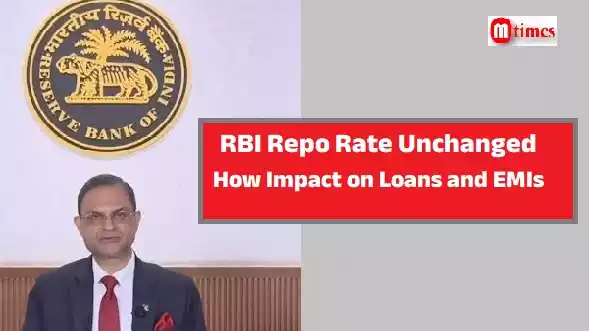

- RBI repo rate unchanged at 5.25 percent with a neutral policy stance.
- Inflation remains within tolerance, growth outlook driven by domestic demand.
- Banks still adjusting to earlier rate cuts, delaying full borrower benefits.
New Delhi: The RBI repo rate unchanged decision sends a clear message to markets and borrowers. Stability now matters more than speed. In my analysis, the central bank is choosing patience as global uncertainty rises and earlier rate cuts are still flowing through the system.
Governor Sanjay Malhotra confirmed that the Monetary Policy Committee unanimously voted to hold the policy repo rate at 5.25 percent. The focus remains on balancing inflation control without choking growth, a tightrope the RBI believes it is managing well.
Why RBI Kept the Repo Rate Unchanged at 5.25 Percent
The data suggests inflation is no longer the immediate threat it once was. Consumer price inflation is below the RBI’s tolerance band, giving policymakers breathing room.
However, what the market is missing is the lag effect of past rate cuts. Between February and June, the RBI slashed rates by 100 basis points, followed by a 25 bps cut in December. Those moves are still working their way through bank lending rates.
Cutting again too early risks overstimulating pockets of the economy while banks have not fully passed on earlier relief.
Neutral Policy Stance Signals a Wait and Watch Phase
The RBI has stuck to a neutral stance for a reason. A neutral policy neither pushes liquidity aggressively nor pulls it back sharply.
In practical terms, this tells banks and businesses to expect stability, not surprises. The central bank wants clarity on how trade agreements, global interest rate trends, and domestic consumption evolve over the next few quarters.
Inflation Outlook and What Changed in RBI Projections
Inflation remains benign, but not invisible. RBI revised its CPI inflation forecast for Q1 and Q2 of FY27 to 4 percent and 4.2 percent.
The slight uptick is driven largely by rising precious metal prices. Underlying inflation, especially food and core services, remains well within comfort levels. This gives the RBI flexibility, but not urgency.
Growth Outlook for India Remains Domestic-Led
India’s growth story is increasingly insulated from global shocks. According to the RBI, domestic consumption, infrastructure spending, and private investment will drive momentum.
Also Read | India-US Trade Agreement Odisha: A New Global Role Emerges
This is critical because global headwinds have intensified. Slower global growth means exports may soften, making domestic demand even more important.
How RBI Repo Rate Unchanged Impacts Loans and EMIs
A lower repo rate only helps borrowers when banks transmit it fully. Right now, transmission is uneven.
Some borrowers have seen marginal EMI relief, others are still waiting. Until banks recalibrate deposit rates and liquidity positions, the full benefit of past cuts will remain delayed.
The second-order effect is important. Once transmission improves, borrowing should pick up, boosting consumption and capital expenditure. That is when growth acceleration becomes visible.
What Comes Next for RBI Policy
The RBI has clearly bought time. Future decisions will hinge on three factors, inflation trajectory, global financial conditions, and how effectively banks pass on rate cuts.
If inflation stays near 4 percent and growth shows signs of slowing, the door to another rate cut opens. Until then, expect policy stability to be the RBI’s preferred weapon.
For markets, borrowers, and businesses, the message is simple. The RBI is not done easing, but it is not rushing either.
Also Read | RBI Repo Rate Unchanged, How Impact on Fixed Deposits
You May Like
Trending Searches Today |
- April 11, 2026 Daily Horoscope Predicts Emotional Balance and Financial Awareness
- Iran Denies Missile Attacks After US Ceasefire
- Odisha SHG Women Self Defence Training Launched for 5,000 Participants
- 10 April 2026 Daily Horoscope: Clarity, Decisions, and New Opportunities
- 9 April 2026 Daily Horoscope Predictions