
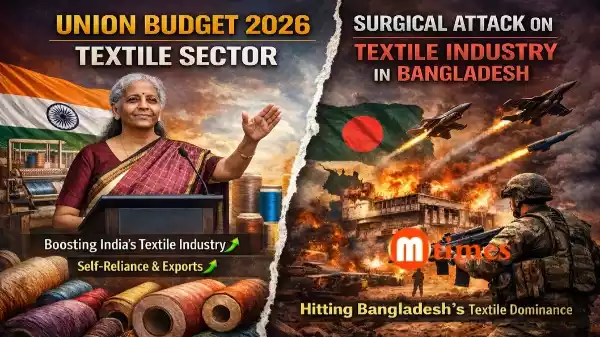

- Union Budget 2026 textile sector measures focus on employment, modernisation and export competitiveness.
- Five integrated programmes were announced, including SAMARTH 2.0 and Text-ECON.
- Mega textile parks and rural handloom initiatives are expected to strengthen India against Bangladesh competition.
Union Budget 2026 Textile Sector: The Union Budget 2026 textile sector measures, presented by Finance Minister Nirmala Sitharaman, have delivered a major policy push for India’s labour-intensive textile industry.
With textiles seen as a cornerstone for employment, rural development and exports, the government’s strategy aims to make India more self-reliant, innovative and globally competitive in the coming years.
Budget 2026 Sets Strong Roadmap for Textile Modernisation
The Finance Minister proposed an integrated programme built around five key pillars designed to strengthen the entire textile value chain.
Also Read | Budget 2026: Rare Earth Corridors India Plan Targets Import Dependence
These initiatives focus on improving domestic fibre production, upgrading clusters, promoting sustainability and building skilled manpower.
Five Key Components Announced for Textile Growth
The new programme includes:
- Self-Reliance in Natural and Technical Fibres
The government aims to boost domestic capacity in silk, wool, jute, man-made and technical fibres to reduce import dependence and secure raw material supply.
- Textile Expansion and Employment Scheme
Traditional textile clusters will receive support for machinery upgrades, technology modernisation, testing facilities and certification centres to enhance global competitiveness.
- National Handloom and Handicraft Programme (NHHP)
The NHHP will integrate existing schemes and provide direct support to artisans and weavers, ensuring better quality production and stronger market access.
- Text-ECON Initiative
This programme will drive innovation, eco-friendly manufacturing practices, design development and sustainability, positioning Indian textiles for global leadership.
- SAMARTH 2.0
SAMARTH 2.0 will upgrade skills across the sector through partnerships with industry and academic institutions, ensuring job-ready talent for modern textile needs.
Mega Textile Parks to Be Developed in Challenge Mode
In a major announcement, Sitharaman said the government will establish mega textile parks under a “challenge mode” approach.
These parks are expected to deliver:
- Large-scale manufacturing efficiency
- Stronger value addition
- Expansion in technical textiles
- Higher export competitiveness
Technical textiles are emerging as a key global segment where India aims to take the lead.
Gram Swaraj Initiative to Strengthen Khadi and Rural Industries
The Budget also introduced the Mahatma Gandhi Gram Swaraj Initiative to empower Khadi, handloom and handicrafts.
This initiative will provide:
- Branding and marketing support
- Global market linkages
- Training and skilling programmes
- Direct benefits to rural youth and ODOP participants
Textile Stocks Rally After Budget Announcements
The market responded positively, with textile stocks witnessing sharp gains.
Top gainers included:
- Kitex Garment
- Pearl Global
- Arvind Ltd
Other export-oriented companies such as Gokaldas Exports, KPR Mill and Welspun Living also recorded strong upticks, reflecting investor confidence in policy continuity.
Challenges Remain in Global Export Environment
Despite the strong policy push, experts warn of short-term challenges, including:
- Volatile global demand
- Trade barriers
- Competition from Bangladesh and Vietnam
The long-term success of Budget measures will depend on linking modernised production with wider global market access and expanding high-value textile segments.
India Targets Strategic Advantage Over Bangladesh
The Budget also signalled India’s intent to make its textile industry more attractive than Bangladesh’s.
With shifting regional dynamics and strained bilateral ties, India is now strategically redefining textile competitiveness to reduce dependence on neighbouring markets and strengthen domestic leadership.
A New Era for India’s Textile Economy
Overall, the Union Budget 2026 textile sector measures mark a decisive step toward building a future-ready textile industry that supports employment, sustainability and export growth.
If implemented effectively, these initiatives could position India as a global textile powerhouse in the years ahead.
You May Like
Trending Searches Today |
- National Maritime Day India: PM Modi Highlights Sector’s Role in Growth
- Mukhyamantri Annapurna Yojana Odisha: Free Rice 5kg for All Beneficiary
- BJP West Bengal CM Face: Party Bets on Modi Over Leadership Pick
- Bhuvneshwar Kumar Nears 200 IPL Wickets Before CSK Clash
- Love Insurance Kompany Trailer Release: Pradeep Ranganathan Stars in Futuristic Love Story