
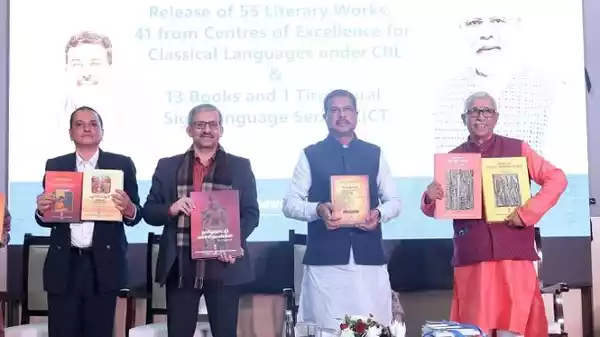


New Delhi: Union Minister for Education Dharmendra Pradhan on Tuesday released a collection of 55 literary works in classical Indian languages, marking a significant step in the government’s ongoing efforts toward the promotion and preservation of India’s rich linguistic and cultural heritage.
The newly released publications span Tamil, Odia, Malayalam, Telugu, Kannada and Indian Sign Language. The initiative forms part of a broader strategy to place Indian languages at the heart of education, research and cultural discourse, while strengthening engagement with classical knowledge systems.
The books were released at a formal event attended by scholars, academics and language experts, highlighting the growing institutional focus on safeguarding India’s literary traditions.
Promotion of Indian Languages Strengthened Through Scholarly Publications
Of the 55 works released, 41 books were developed by the Centres of Excellence for Classical Languages under the Central Institute of Indian Languages. In addition, 13 books and a special Tirukkural Sign Language series were brought out by the Central Institute of Classical Tamil.
The collection includes authoritative scholarly works across Kannada, Telugu, Malayalam, Odia and Tamil. A key highlight is the interpretation of the Tirukkural in Indian Sign Language, which reflects a growing emphasis on accessibility and inclusive learning.
Officials said the initiative aims to nurture cultural pride, deepen academic research in classical texts, and ensure that India’s linguistic heritage remains relevant for future generations.
Indian Languages as a Unifying National Strength
Addressing the gathering, Pradhan said that under the leadership of Prime Minister Narendra Modi, sustained efforts have been undertaken to strengthen Indian languages. These include expanding the list of scheduled languages, translating classical texts into Indian languages, and encouraging education in mother tongues.
The minister noted that Indian languages have survived despite historical attempts to marginalise them and said linguistic diversity is one of India’s greatest strengths. He emphasised that society bears a collective responsibility to preserve the nation’s historical, cultural and literary wealth.
Also Read | Best 5 Stocks to Buy Long-Term
Pradhan reiterated that languages serve as a unifying force in India and stressed that all Indian languages should be regarded as national languages, reflecting the country’s ethos of unity in diversity.
Promotion of Indian Languages Through Inclusive and Accessible Knowledge
Highlighting the inclusion of the Tirukkural in Indian Sign Language, the minister said the initiative represents the vision of an inclusive India, ensuring that knowledge reaches wider sections of society, including the hearing-impaired community. He described the release as a meaningful contribution to India’s intellectual and literary corpus.
Pradhan also pointed out that the National Education Policy 2020 strongly promotes education in Indian languages and reinforces India’s civilisational tradition of dialogue, harmony and coexistence. He added that NEP 2020 positions language as a bridge connecting generations, cultures and ideas.
The release of these works, officials said, is expected to play a key role in revitalising interest in classical languages and strengthening India’s cultural foundations through education and research.
You May Like
Trending Searches Today |
- Indian Stock Market Today: Sensex, Nifty End Lower, Market Under Pressure
- UPI Payments in Uzbekistan Get Major Boost For Indians
- Supreme Court Rejects Plea on Ethanol Content in Petrol
- Dhenkanal Rice ATM Opens for 24-Hour Rice Access
- India, Uzbekistan Elevate Ties to Comprehensive Strategic Partnership:PM Modi
Amazon Online Shopping