

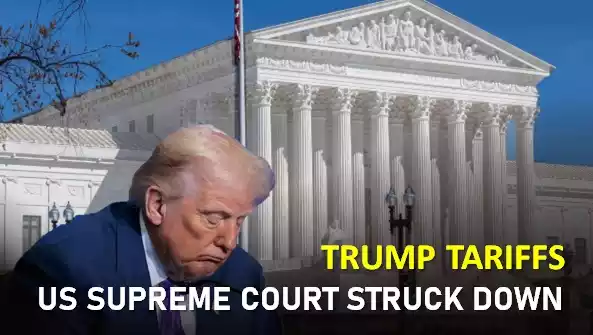

- Supreme Court ruled presidents lack authority to impose tariffs under IEEPA
- 6–3 verdict curbs Donald Trump’s use of emergency trade powers
- Decision could trigger over $100 billion in tariff refunds
The US Supreme Court struck down Trump tariffs in a landmark 6–3 ruling, holding that a key emergency statute does not give the president authority to impose sweeping trade duties. The decision represents a major judicial check on Donald Trump’s tariff-driven economic strategy and has far-reaching legal, economic, and political consequences.
The ruling invalidates many tariffs imposed during Trump’s second term, which were central to his approach to trade negotiations and foreign policy leverage.
A Rare Judicial Rebuff to Presidential Power
The majority opinion united an unusual coalition: Chief Justice John Roberts alongside Justices Sonia Sotomayor, Elena Kagan, Neil Gorsuch, Amy Coney Barrett, and Ketanji Brown Jackson.
Justices Clarence Thomas, Samuel Alito, and Brett Kavanaugh dissented.
At the heart of the dispute was the International Emergency Economic Powers Act (IEEPA).
Why the Court Rejected Trump’s Tariff Authority
1. Emergency Law Never Mentions Tariffs
The court noted that IEEEPA allows presidents to “regulate importation” during emergencies—but never uses terms like tariff, duty, tax, or levy. The absence of explicit language proved decisive.
2. No Historical Precedent
Before Trump, no president had used IEEPA to impose tariffs. The justices said this long-standing practice strongly suggests Congress never intended to grant such authority.
3. Tariffs Are Fundamentally Different
The court distinguished tariffs from tools like quotas or embargoes. Tariffs directly raise revenue for the US Treasury and burden domestic importers, placing them outside the law’s intended scope.
4. Risk of Unlimited Executive Power
Accepting the government’s interpretation would allow a president to impose tariffs of any size, on any country, for any duration—a level of power Congress did not clearly authorize.
5. Major Questions Doctrine Applied
Chief Justice Roberts and Justices Gorsuch and Barrett invoked the major questions doctrine, which requires explicit congressional approval for actions with vast economic or political consequences.
6. Unanimity on the Core Issue
Despite differing legal reasoning, all six majority justices agreed that IEEEPA does not authorize tariffs.
7. Roberts’ Central Finding
Roberts wrote:
“Our task today is to decide only whether the power to ‘regulate … importation’ embraces the power to impose tariffs. It does not.”
8. Other Emergency Tools Still Available
The ruling clarified that IEEEPA still permits measures like quotas and embargoes, but tariffs are a separate, revenue-raising instrument.
9. Broad Economic Impact Considered
The invalidated tariffs had driven up prices on furniture, apparel, electronics, and other imports. Economists warn price relief may be slow due to policy uncertainty.
10. Massive Legal and Financial Fallout
The decision opens the door to refunds exceeding $100 billion to importers. Agencies including the US Court of International Trade, Customs and Border Protection, and the Treasury are expected to oversee implementation. Consumers’ compensation remains uncertain.
Trump’s Response and India Angle
Trump reacted angrily, quickly announcing a new 10% global tariff under Section 122 of the 1974 Trade Act, a provision never previously used. He also signalled further action through Section 301 investigations.
Crucially, Trump insisted the ruling would not affect the India–US trade deal, saying India would continue paying tariffs while the US would not. He praised Narendra Modi, calling the revised arrangement “fair,” even as he criticised earlier trade terms.
What Comes Next
The ruling sharply narrows presidential tariff powers and ensures future trade duties must rest on clear congressional authorization. While Trump is already testing alternative legal routes, the decision marks a pivotal moment in the balance between executive authority and legislative control over US trade policy.
You May Like
Trending Searches Today |
- Bhubaneswar Durga Puja Traffic Advisory: Routes, Diversions
- UPI Merchant Charges to Begin After Diwali, NPCI Announces
- Indian Army Launches Bharat Rice for Troops, Signs MoU With FCI
- Odisha Durga Puja Rain Forecast: Low-Pressure System Possible
- IIIT Ranchi Student Found Dead in Hostel, Students Protest
Amazon Online Shopping


