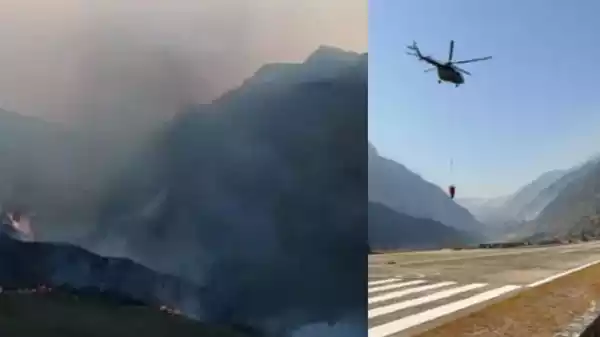

- Arunachal Pradesh and Nagaland forest fires are being tackled through joint Army–IAF operations.
- Helicopters have dropped nearly 1.4 lakh litres of water in difficult terrain.
- Authorities cite dry weather and jhum cultivation as key causes of the blazes.
New Delhi: Relentless efforts are underway to contain the Arunachal Pradesh and Nagaland forest fires, with the Indian Army and the Indian Air Force conducting round-the-clock aerial and ground operations. Helicopters are carrying out continuous water-dropping missions, while specialised firefighting teams work in extremely challenging terrain.
Officials say sustained aerial support has been critical in preventing the fires from spreading across remote and ecologically sensitive regions.
IAF Helicopters Fight Fires in Arunachal and Nagaland
The Indian Air Force confirmed that its helicopters are operating simultaneously on two major fronts. In Walong, located in Arunachal Pradesh, aerial crews have dropped nearly 139,800 litres of water, successfully extinguishing a major blaze.
Operations are also continuing over the Dzukou Valley in Nagaland, where Mi-17 V5 helicopters are drawing water from Padumpokhiri Lake in Dimapur to combat fires near Japfu Peak. The missions are being carried out amid steep slopes, poor visibility, and rarefied air.
Army and IAF Coordinate at Walong Fire Zone
The forest fire in Walong, a remote area in the Anjaw district of Arunachal Pradesh, broke out on February 13. Situated at an altitude of around 3,000 to 3,500 feet, the region poses severe access challenges for ground-based firefighting.
Also Read | Election Commission Suspends Six Officials in West Bengal Over SIR Irregularities
Indian Army troops, supported by IAF helicopters, have deployed heavy machinery, specialised equipment, and ground teams to contain the blaze. Videos released by the Army show helicopters dropping water over burning hills while personnel work to secure fire lines on the ground.
High-Altitude Operations in Lohit Valley
Earlier, the IAF reported sustained firefighting missions above 9,500 feet in the Lohit Valley of Arunachal Pradesh. Over 12,000 litres of water were delivered in multiple sorties, targeting hotspots along narrow ridgelines overlooking the valley.
Despite inclement weather and low oxygen levels, helicopters executed precision drops to protect the fragile Himalayan ecosystem, with operations continuing as conditions permit.
Causes and Challenges Behind Northeast Forest Fires
According to defence officials in Guwahati, prolonged dry weather and jhum cultivation a traditional slash-and-burn agricultural practice are among the primary triggers for forest fires in the Northeast.
Over the past five days, coordinated efforts involving manpower, aerial reconnaissance, water-dropping missions, and heavy equipment have been conducted round-the-clock under harsh weather and terrain conditions.
Aerial Support Proves Crucial
Authorities stressed that the combined Army and IAF response has been vital in preventing the fires from spreading further. In steep and inaccessible areas, helicopters remain the most effective tool to control flames and support ground teams.
The ongoing operations against the Arunachal Pradesh and Nagaland forest fires highlight the critical role of military-led aerial firefighting in safeguarding remote Himalayan regions and preventing ecological damage.
You May Like
Trending Searches Today |
- EPFO Credits August Pension Early Ahead of Onam Keralam Zone
- PM Modi Extends Onam Wishes, Highlights Unity and Prosperity
- Jai Jagannath Row: Puri Shankaracharya Opposes Animated Film On Jagannath
- Maruti Suzuki Jimny Price Hiked by ₹15,000
- OMFED Paneer Quality Assured Amid Adulteration Crackdown
Amazon Online Shopping