
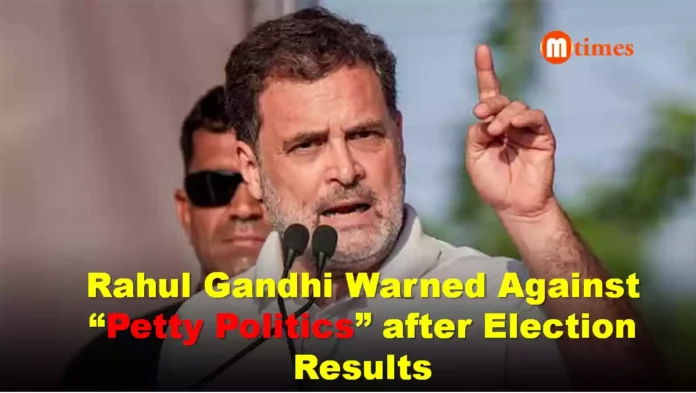

- Rahul Gandhi warned against “petty politics” after election results
- He alleged a larger threat to democratic institutions
- Congress leader called for opposition unity
New Delhi: The remarks by Rahul Gandhi on the West Bengal Assam elections have intensified the political narrative beyond state-level results, as he cautioned opposition parties against what he termed “petty political reactions” and urged a broader reassessment of the implications for Indian democracy.
In a pointed message, Gandhi criticized sections within the opposition for celebrating the setback of the All India Trinamool Congress in West Bengal, arguing that such reactions miss the larger picture.
He framed the outcomes not as isolated electoral shifts, but as part of a deeper institutional challenge.
Rahul Gandhi on West Bengal, Assam Elections: Why His Warning Matters
Gandhi’s intervention reflects a strategic shift in messaging.
Rather than focusing on party-level gains or losses, he attempted to reposition the narrative as a structural issue concerning democratic integrity.
His allegation that the mandate in West Bengal and Assam was “stolen” directly targets the credibility of the electoral process, a claim the Bharatiya Janata Party has strongly rejected.
This kind of framing is politically significant because it seeks to unify fragmented opposition forces under a common concern rather than competitive rivalry.
From Electoral Contest to Institutional Debate
By emphasizing democracy over party politics, Gandhi is attempting to move the conversation from electoral arithmetic to institutional trust.
This shift matters because it: Changes voter perception from winners versus losers to system versus safeguards, and reframes future elections as part of a larger ideological contest.
Such positioning could influence how opposition alliances are built ahead of upcoming national and state elections.
Why Opposition Unity Is Central to His Message
Gandhi’s call to “put petty politics aside” highlights a long-standing challenge within opposition ranks.
The relationship between Congress and regional parties like the Trinamool Congress has often oscillated between cooperation and rivalry.
By urging restraint and unity, Gandhi is signaling an attempt to reduce fragmentation, at least at a narrative level.
Whether this translates into practical alliances remains uncertain, but the messaging indicates a recognition that divided opposition weakens electoral competitiveness.
Political Reactions and Counter-Narratives
While opposition parties have echoed concerns over election conduct, the BJP has dismissed such allegations and defended both the process and results.
This sharp divide reflects a broader pattern in Indian politics, where electoral outcomes increasingly trigger competing narratives about legitimacy and governance.
Second-Order Effects on National Politics
Gandhi’s framing could have ripple effects beyond West Bengal and Assam.
Shape future campaign narratives, influence alliance-building strategies, and intensify debates around institutional independence.
In a political landscape where perception often drives momentum, such statements are aimed as much at public sentiment as at party leadership.
The Rahul Gandhi on West Bengal, Assam elections remarks signal an effort to elevate the political conversation from state results to national democratic concerns.
Whether this approach strengthens opposition cohesion or remains rhetorical will depend on how parties respond in the coming months.
For now, Gandhi’s message is clear, electoral outcomes are not just about power shifts, but about how those shifts are interpreted within the larger framework of India’s democratic system.
Also Read | Rohit Jain Named RBI Deputy Governor for Three Years as India Strengthens Monetary Leadership
You May Like
Trending Searches Today |
- Mirzapur: The Movie Review and Cast
- IDCO Approves Land for 37 Industrial Projects in Odisha
- Nuakhai 2026 Lagna Fixed for September 15 in Sambalpur
- Mithun Chakraborty Named Bengal Government Cultural Advisor
- Janmashtami 2026 in Odisha: Puri, Bhubaneswar Celebrations
Amazon Online Shopping