
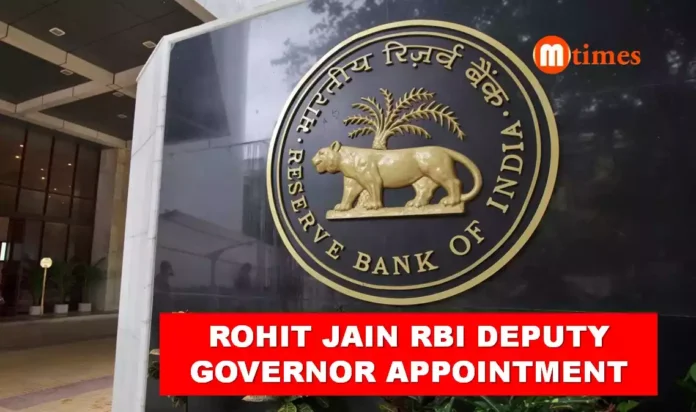

- Rohit Jain has been appointed RBI Deputy Governor for a three-year term
- He succeeds T Rabi Sankar after his retirement
- The appointment comes during a critical phase for India’s economic management
New Delhi: The appointment of Rohit Jain RBI Deputy Governor marks a major institutional development for India’s financial architecture, with the Appointments Committee of the Cabinet approving his elevation from RBI Executive Director to one of the country’s most influential economic leadership positions.
Jain replaces T Rabi Sankar, whose retirement last month created a vacancy at a time when the Reserve Bank of India is managing multiple economic pressures, including inflation discipline, liquidity stability, and sustainable growth.
This transition is significant because Deputy Governors are not merely senior administrators, they are central to shaping the operational backbone of India’s monetary and regulatory framework.
Rohit Jain RBI Deputy Governor Appointment: Why It Matters Now
Rohit Jain’s appointment arrives at a time when central banking decisions are increasingly under national and global scrutiny.
India’s economy is navigating a delicate phase where growth ambitions must be balanced against inflation risks, global capital volatility, and domestic credit expansion. In this environment, RBI leadership continuity becomes especially important.
As Deputy Governor, Jain is expected to influence banking supervision, policy transmission, financial system resilience, and liquidity management, all of which directly affect businesses, consumers, and investors.
Why RBI Leadership Shapes Everyday Economic Reality
For ordinary citizens, RBI decisions may appear distant, but they shape:
Home loan costs, deposit rates, borrowing conditions, inflation control, and banking system trust.
This is why leadership changes inside the RBI often carry second-order effects far beyond financial markets.
A steady hand can:
Support policy predictability, reduce institutional uncertainty, and strengthen confidence in India’s financial governance.
Internal Promotion Signals Continuity Over Disruption
Jain’s rise from Executive Director suggests the government and RBI are prioritizing institutional familiarity.
This matters because leaders from within the system often bring:
A stronger grasp of policy continuity, smoother transition capacity, and deeper operational understanding.
In periods of economic complexity, continuity can often be more valuable than abrupt strategic shifts.
RBI’s Expanding Role Beyond Traditional Banking
Founded in 1935 and nationalized in 1949, the Reserve Bank of India has evolved from a conventional central bank into a strategic institution managing:
Monetary policy, inflation, financial regulation, liquidity systems, and economic modernization.
Today, RBI’s decisions influence not only banking, but also India’s broader investment climate and development trajectory.
What Rohit Jain’s Appointment Could Mean Going Forward
Jain’s tenure will likely be judged by how effectively RBI can maintain:
Price stability without choking growth, strong liquidity without financial excess, and policy discipline without undermining market confidence.
As India pushes toward larger economic ambitions, including digital finance expansion and deeper rural financial inclusion, Deputy Governor-level leadership will increasingly shape long-term outcomes.
Also Read | Sandeep Pathak Faces FIRs After BJP Switch
The Rohit Jain RBI Deputy Governor appointment is more than a leadership change, it is a strategic move during a period when monetary credibility is deeply tied to national economic momentum.
His role will likely influence not only central bank operations, but also how effectively India balances growth, inflation, and financial resilience in an increasingly unpredictable global economy.
You May Like
Trending Searches Today |
- Bhubaneswar Durga Puja Traffic Advisory: Routes, Diversions
- UPI Merchant Charges to Begin After Diwali, NPCI Announces
- Indian Army Launches Bharat Rice for Troops, Signs MoU With FCI
- Odisha Durga Puja Rain Forecast: Low-Pressure System Possible
- IIIT Ranchi Student Found Dead in Hostel, Students Protest
Amazon Online Shopping