
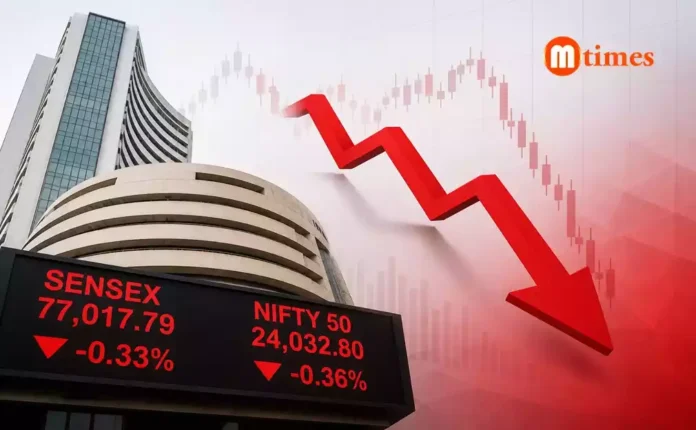

- Sensex and Nifty ended lower despite second-half recovery
- Midcap and smallcap indices outperformed benchmarks
- Banking stocks remained the key drag on market sentiment
Mumbai: The Indian stock market closed lower on Tuesday, even as a sharp rebound in the second half helped trim early losses. Investors remained cautious amid mixed global signals and uneven sectoral performance.
The Nifty 50 settled at 24,032.80, down 86.50 points (-0.36%), while the BSE Sensex ended at 77,017.79, falling 251.61 points (-0.33%).
Late Recovery Fails to Lift Benchmarks
Markets traded with a bearish bias in the morning session, tracking weak global cues. However, buying interest in select stocks helped indices recover partially in the second half.
Despite this bounce, benchmarks failed to enter positive territory, indicating continued caution among investors.
Broader Market Shows Strength: Sensex and Nifty Ended Lower
In contrast to the headline indices, the broader market displayed resilience.
Both the Nifty Midcap 100 and Nifty Smallcap 100 ended in the green, reflecting sustained buying in mid and small-cap stocks. Market breadth remained stable, with 240 stocks in the Nifty 500 closing higher, suggesting selective accumulation.
This divergence indicates that investors are increasingly focusing on stock-specific opportunities rather than broad market direction.
Sectoral Trends Remain Mixed
Sector performance was uneven through the session.
Auto and FMCG stocks saw gains, supported by selective buying in consumption-driven sectors. On the flip side, realty and consumer durable stocks dragged the market lower.
Among individual stocks, M&M and UltraTech Cement were among the top gainers, while Jio Financial and ICICI Bank weighed on the indices.
Banking Stocks Continue to Lag
The Bank Nifty underperformed again, ending 0.60% lower.
Weakness in banking stocks remained a key factor limiting market upside, as the sector failed to participate meaningfully in the recovery.
Global Cues Keep Sentiment in Check
Global markets remained cautious due to ongoing tensions between the US and Iran, particularly around the Strait of Hormuz.
Asian markets declined, while US and European futures indicated a subdued opening. Oil prices, although slightly lower, continued to stay above $100 per barrel, raising concerns about inflation and input costs.
What This Means for Investors
The current market setup reflects a lack of clear direction in benchmark indices, while broader segments continue to attract interest.
Investors appear to be:
Focusing on earnings visibility, shifting towards mid and small caps, and avoiding sectors facing macro pressure like banking.
The Indian stock market closes lower trend highlights a phase of consolidation, where global uncertainty and sectoral divergence are shaping market moves.
Going forward, market direction is likely to depend on global developments, sector rotation, and stock-specific triggers rather than broad-based momentum.
Also Read | Rahul Gandhi on West Bengal, Assam Elections: Congress Leader Warns of ‘Deeper Threat’ to Democracy
You May Like
Trending Searches Today |
- Kolkata Durga Puja Stampede Kills 19, 25 Injured; CM Announces Rs 25 lakh Aid and Government Jobs
- Air India and Air India Express Suspends Jeddah, Riyadh and Dammam Flights
- FSSAI Proposes Ban on Added Sucrose and Fructose in Infant Foods
- Ramayana Film: Cast, Music, Visuals and Release Details
- Tesla Roadster Unveiled With Thrusters and Flying Features
Amazon Online Shopping