
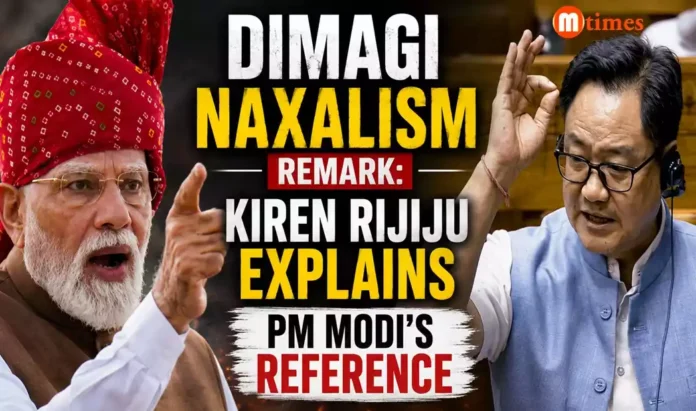

- Kiren Rijiju clarified that PM Modi’s dimagi Naxalism remark was not aimed at Opposition leaders.
- Rijiju said the term referred to people who support Maoists, reject the Constitution or back separatist causes.
- Congress leaders P. Chidambaram and Jairam Ramesh criticised the Prime Minister’s remarks.
NEW DELHI: The dimagi naxal remark made by Prime Minister Narendra Modi during his Independence Day address has triggered a fresh political confrontation, with the government and Opposition offering sharply different interpretations of what the phrase means.
Union Parliamentary Affairs Minister Kiren Rijiju sought to clarify the controversy on Sunday, saying Modi had not labelled Opposition leaders as “dimagi Naxals.” He argued that the Prime Minister was referring to forces that seek to undermine India’s constitutional framework and create conditions for violence and disorder.
The clarification came after Congress leaders accused Modi of using provocative language against political opponents.
Dimagi Naxal Remark: Kiren Rijiju Explains PM Modi’s Reference
In a post on X, Rijiju said the Prime Minister’s comment was not directed at Opposition leaders. He instead listed groups and positions that, according to him, fit the description used by Modi.
Rijiju said the term applied to those who support Maoists and reject the Indian Constitution, those who support separatists and Article 370, and those who seek to sever the Northeast from the rest of India.
The clarification attempts to shift the debate away from party politics and towards national security, constitutional loyalty and separatism. However, the Opposition’s reaction indicates that the political dispute over the terminology is unlikely to end quickly.
Dimagi Naxal Remark Draws Congress Response
Senior Congress leader P. Chidambaram responded to Modi’s remarks by saying on X, “I am proud to be a dimagi naxal!”
His response was followed by criticism from Congress General Secretary Jairam Ramesh, who linked the latest phrase to Modi’s previous use of the term “urban Naxals.”
Ramesh argued that the use of labels such as “urban Naxals” and now “dimagi Naxals” reflected what he described as political desperation.
PM Modi’s Dimagi Naxal Warning
During his Independence Day address, Modi said armed Naxalism had been significantly weakened in India’s forests but warned that what he called “dimagi Naxalism” remained a challenge.
According to the Prime Minister, people with such a mindset could seek opportunities to encourage violence and social unrest. He called for such forces to be identified and isolated while urging efforts to connect young people with the mainstream.
The statement places the issue within the government’s broader narrative on national security and the decline of armed Left Wing Extremism. The Opposition, however, has interpreted the terminology as part of a growing pattern of political attacks.
The controversy now centres on whether “dimagi naxal” is being used as a specific description of anti constitutional and separatist forces, as Rijiju argues, or as a political label for dissenting voices, as Congress leaders contend.
The competing interpretations are likely to keep the issue alive, particularly as both sides use the debate to reinforce their wider arguments over nationalism, constitutional values and the limits of political rhetoric.
You May Like
Trending Searches Today |
- PM-SETU Approves ₹1,194 Crore for ITI Clusters in Odisha
- Odisha CM Approves ₹56.55 Crore for Sarpanch And Naib Sarpanch Honorariums
- Reliance Welcomes Starlink as Elon Musk Questions India Entry
- Jio Platforms IPO: Price Band, Dates and Key Details
- ED Raids 12 Premises in Odisha SI Recruitment Paper Leak Case In Odisha And West Bengal
Amazon Online Shopping