
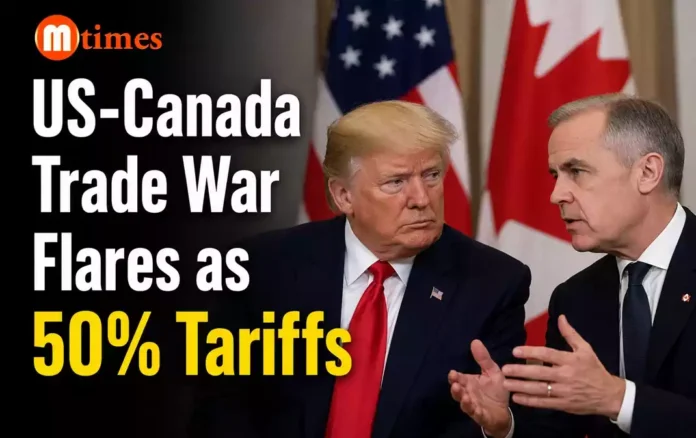

- The US-Canada trade war escalated after last-minute negotiations failed to produce a trade agreement.
- The United States has imposed 50% tariffs on about $20 billion of Canadian imports under Section 338.
- Canadian Prime Minister Mark Carney has suspended negotiations and pledged matching tariffs.
Washington, DC: The US-Canada trade war has entered a new phase after last-minute negotiations between Washington and Ottawa collapsed, triggering new US tariffs of up to 50% on selected Canadian goods.
The tariffs took effect early Saturday after the two sides failed to finalise a deal before the deadline. Prime Minister Mark Carney said Canada was suspending trade negotiations and would respond with matching measures to protect Canadian businesses and workers.
The immediate tariff action covers roughly $20 billion worth of Canadian products, a relatively small portion of overall bilateral trade but a significant escalation in the dispute between the two North American partners.
US Canada Trade War Escalates After Talks Collapse
The negotiations had appeared close to a breakthrough earlier in the week. President Donald Trump had postponed the tariff deadline by three days while the two governments worked towards a possible agreement.
That optimism disappeared during Friday’s final negotiations.
Carney said changes made by the US at the last stage of the talks were unacceptable and led him to suspend the negotiations. US Trade Representative Jamieson Greer, however, said Canada had declined to finalise terms that Washington believed had already been agreed.
The disagreement centred on several sensitive areas, including automobiles, steel, aluminium, lumber, dairy access and other trade restrictions.
US Canada Trade War Brings Section 338 Into Focus
The latest tariffs are being imposed under Section 338 of the US Tariff Act of 1930, a rarely used provision that allows the US president to impose duties of up to 50% in response to what the administration determines to be discriminatory treatment of American commerce.
The United States says Canadian policies affecting areas such as dairy, alcohol and automobiles disadvantage American exporters.
Canada disputes Washington’s approach and argues that the last-minute US proposals undermined the progress achieved during negotiations.
The targeted products include items such as cement, wood products and other Canadian goods. Some major Canadian exports, including certain energy and other strategic supplies, have not been included in the latest action.
Canada Announces Dollar-for-Dollar Tariff Response
Carney has pledged that Canada will match the new US tariffs dollar for dollar.
Ottawa’s response could increase costs for businesses on both sides of the border if the measures remain in place and expand into additional product categories.
The immediate economic effect may be limited because the newly targeted goods account for only a small share of total Canadian exports to the United States. The bigger concern is the possibility of further retaliation and prolonged uncertainty for manufacturers, exporters and consumers.
The dispute also creates complications for the future of the USMCA, the North American trade framework governing the United States, Canada and Mexico.
Both countries have strong economic links, with supply chains crossing the border in sectors including automobiles, energy, manufacturing, agriculture and industrial goods. Prolonged tariff uncertainty could therefore affect investment decisions even where products are not directly covered by the latest duties.
For Canada, the latest confrontation is also strengthening the argument for diversifying trade relationships and reducing excessive dependence on the US market.
For Washington, the dispute reflects Trump’s broader strategy of using tariffs as leverage to secure changes in foreign trade policies.
The next stage will depend on whether the two governments return to negotiations or allow the retaliatory measures to remain in place. For businesses, the immediate challenge is managing higher trade costs while the future of the bilateral relationship remains uncertain.
You May Like
Trending Searches Today |
- Sanju Samson Praises Team Effort After India Beat New Zealand in First T20I
- Bitcoin Vs Gold Vs Nifty 50: Which Investment Delivered The Best 5-Year Returns?
- Amit Shah Hits Back at Rahul Gandhi Over ‘Vote Chori’ Claims, Targets Over Foreign Visits
- Ravana Podi in Bhubaneswar at Nine Locations Today
- CJP Leaders Withdraw Delhi High Court Plea Over Custody
Amazon Online Shopping