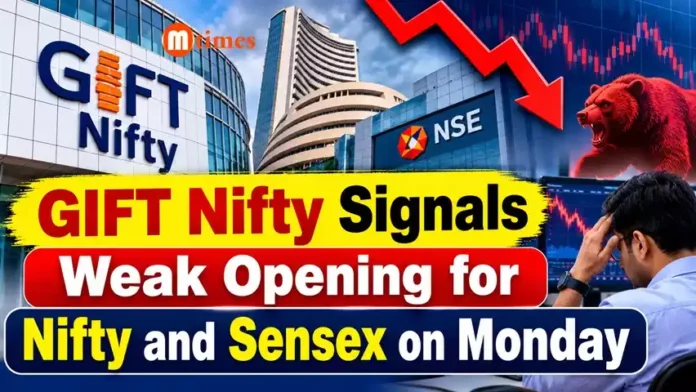

- GIFT Nifty traded at a discount of around 82 points to the Nifty 50’s Friday closing level, indicating a possible weak opening on Monday.
- The Sensex and Nifty recorded their seventh consecutive session of gains on Friday, with weekly gains of 8.82% and 8.58%, respectively
- Muhurat trading will take place on Sunday, November 8, while regular trading resumes Monday, November 9.
Mumbai: Indian stock markets may begin Monday’s trading session on a weak note, as GIFT Nifty futures indicate a possible gap-down opening for the Sensex and Nifty 50. The negative signal comes after a strong seven-session winning streak in domestic equities and a sharp sell-off across major Asian markets.
According to market analysts, the near-month GIFT Nifty contract was trading at 24,948 on Friday, down 44 points or 0.18% from its previous close of 24,992.
Against the Nifty 50’s closing level of 25,030.35, GIFT Nifty was at a discount of approximately 82.35 points, or 0.33%. This indicates the possibility of a lower opening when regular trading resumes on Monday.
However, GIFT Nifty is an early indicator, and the actual market opening may change depending on global cues and trading activity.
Sensex and Nifty Extend Winning Streak
Indian equity benchmarks ended Friday’s session with strong gains despite weak global signals.
The Sensex climbed 1,718.01 points, or 2.17%, to close at 81,028.02. The Nifty 50 advanced 493.75 points, or 2.01%, to settle at 25,030.35.
The Nifty also crossed the 24,900 mark for the first time since February 27, 2026.
For the week, the Sensex gained 8.82%, while the Nifty 50 advanced 8.58%.
Falling crude oil prices, foreign fund inflows, encouraging corporate earnings and a stronger rupee supported investor sentiment during the week.
Asian Markets Witness Sharp Sell-Off
Global market weakness remains a major concern for domestic investors.
Asian equities recorded significant losses on Friday, with Japan, South Korea and Taiwan among the worst-hit markets.
Key market movements included:
- Japan’s Nikkei: Fell 5.96% to 57,434.77.
- South Korea’s Kospi: Declined 6.02% to 5,059.69.
- Taiwan: Dropped 4.51% to 39,701.64.
- Hong Kong’s Hang Seng: Lost 1.27% to 24,481.86.
- Shenzhen: Fell 2.57% to 11,175.78.
The broad-based decline in Asian markets could influence investor sentiment when Indian exchanges reopen.
Crude Oil Prices Remain in Focus
Crude oil prices were relatively stable on Friday.
Brent crude slipped 0.18% to USD 98.11 per barrel, while West Texas Intermediate (WTI) edged up 0.09% to USD 90.60.
Lower crude prices are generally positive for India because the country depends heavily on imported oil. A decline can help reduce the import bill and ease inflationary pressure.
Investors will continue tracking crude oil movements and global developments for further market direction.
Muhurat Trading on Sunday, November 8
Indian stock exchanges will conduct a special Muhurat trading session on Sunday, November 8, on the occasion of Diwali Lakshmi Pujan.
Regular trading will resume on Monday, November 9.
The NSE and BSE will remain closed on Tuesday, November 10, for Diwali Balipratipada.
Investors should therefore keep the special Sunday session in mind while preparing for the next regular trading week.
What Should Investors Watch on Monday?
Market participants are likely to monitor several important factors before taking trading decisions:
- GIFT Nifty movement ahead of the opening bell.
- Performance of Asian and US markets.
- Foreign institutional investor activity.
- Crude oil prices and currency movements.
- Fresh corporate earnings and global economic developments.
Although the recent rally has strengthened domestic market sentiment, sharp losses in global equities could trigger volatility and profit-booking.
Disclaimer: This article is for informational and educational purposes only and does not constitute investment advice or a recommendation to buy or sell any securities. Stock market investments are subject to market risks. Investors should conduct independent research or consult a qualified financial adviser before making investment decisions.
You May Like