
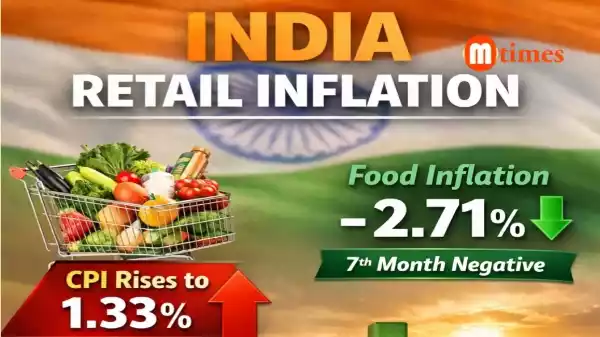


New Delhi: India retail inflation December 2025 inched up to 1.33 per cent, compared with 0.71 per cent in November, according to official data released on Monday. While headline inflation showed a marginal increase, food inflation continued to remain in negative territory, reinforcing expectations of a benign price environment and providing policy comfort to the central bank.
Food inflation stood at –2.71 per cent during the month, marking the seventh consecutive month of year-on-year contraction in food prices. Although still in deflation, the reading was slightly higher than the –3.91 per cent recorded in November, indicating selective price pressures in certain food categories.
India Retail Inflation December 2025 Driven by Select Price Pressures
According to the official statement, the modest uptick in both headline and food inflation during December was driven by rising prices of personal care and effects, vegetables, meat and fish, eggs, spices and pulses. These increases partially offset the broader decline in food prices witnessed over recent months.
Also Read | India GDP Growth Seen at 7.4% in FY26, Services Sector to Lead Expansion
Despite these pressures, economists noted that the overall inflation trajectory remains well within comfort levels, supported by easing food costs and stable core inflation.
RBI Inflation Outlook and Monetary Policy Stance
The Reserve Bank of India has maintained a positive outlook on inflation dynamics. The RBI’s Monetary Policy Committee (MPC) last month revised its inflation projection for 2025–26 downward to 2 per cent from an earlier estimate of 2.6 per cent, citing a sharp moderation in food prices and the impact of Goods and Services Tax (GST) rate cuts.
RBI Governor Sanjay Malhotra recently announced a 25 basis point reduction in the repo rate, bringing it down to 5.25 per cent. He said easing inflation conditions have created room for the central bank to focus on supporting economic growth. The Governor described the current macroeconomic environment as a “Goldilocks period,” marked by strong growth and low inflation, noting that GDP expanded by 8.2 per cent in the second quarter of the ongoing financial year.
Core Inflation, Food Supply and Global Factors
The RBI highlighted that headline inflation has softened more than previously anticipated, largely due to exceptionally low food prices. This has prompted a downward revision in inflation projections for both 2025–26 and the first quarter of 2026–27.
Core inflation, which excludes food and fuel, has remained largely contained. Excluding the impact of gold prices, core inflation moderated to 2.6 per cent in October, suggesting that underlying price pressures are becoming more broad-based and manageable.
The central bank also pointed to improved food supply conditions, supported by higher kharif output, healthy rabi sowing, adequate reservoir levels and favourable soil moisture. Additionally, global commodity prices barring a few metals are expected to soften, further supporting a stable inflation outlook in the months ahead.
You May Like
Trending Searches Today |
- Daily Horoscope March 30 2026: What Stars Say About Love, Money, and Career
- Modi Mann Ki Baat West Asia Warning: PM Urges Unity Amid Global Crisis
- Mohan Bhagwat Illegal Immigration Remarks Spark Debate on Population and Three-Child Policy
- MI vs KKR IPL 2026 Preview Wankhede Set for High Scoring Thriller
- Madhavpur Mela Gujarat 2026: PM Modi Highlights Cultural Unity and Heritage
Amazon Online Shopping