
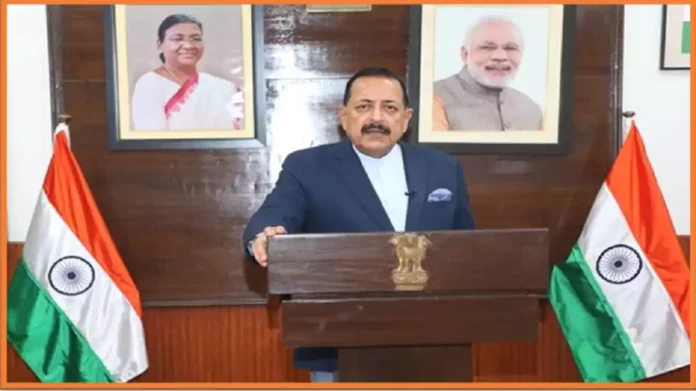

- Jitendra Singh says technology will define India’s future national power
- Calls for India to shift from tech consumer to global innovation leader
- IIT diaspora positioned as key bridge to international technology ecosystems
New Delhi: The India technology leadership vision is rapidly becoming central to the country’s long-term strategy, with Science and Technology Minister Jitendra Singh stating that technological capability will define national strength in the coming decades.
Addressing the PAN-IIT Alumni Conference in Los Angeles, Singh made it clear that India’s ambitions must extend beyond technology adoption. The bigger objective is to become a creator, designer, and global force in emerging technologies.
India Technology Leadership Vision: Why the Shift Matters
India’s economic and geopolitical future increasingly depends on its position in critical technologies such as AI, semiconductors, biotech, quantum systems, and deep-tech manufacturing.
For years, India has excelled as a large consumer market and IT services powerhouse. But Singh’s message signals a strategic shift, India must now control intellectual property, product design, and frontier innovation.
This transition matters because nations that dominate technology standards often shape global power structures, trade advantages, and strategic autonomy.
From Consumer to Creator: The Core Challenge
Moving from user to innovator requires more than startup enthusiasm.
Singh emphasized stronger coordination between academia, government, and industry, a critical factor because fragmented innovation systems often struggle to commercialize research.
This means universities must become stronger research engines, industries must invest more aggressively in R&D, and policy frameworks must support scalable innovation.
Without institutional redesign, India risks remaining a service provider instead of a technology architect.
IIT Diaspora’s Strategic Role in India’s Growth
A major part of Singh’s message focused on the Indian diaspora, especially IIT alumni.
He described them as connectors between India and global innovation ecosystems, a significant point because diaspora networks often provide:
- Venture capital access
- Research partnerships
- Policy influence
- Institutional mentorship
This is a second-order advantage. Rather than building every ecosystem from scratch, India can leverage global Indian professionals to accelerate domestic capability.
Why Education and Institution Building Are Now Critical
Singh also stressed the need for new educational models.
Traditional systems focused heavily on degrees and placements may no longer be enough in a world shaped by AI disruption and technological competition.
India will likely need institutions that prioritize:
- Deep research
- Advanced manufacturing
- Entrepreneurial problem-solving
- Global collaboration
This could redefine how higher education contributes to national strategy.
Second-Order Impact on India’s Global Position
If India successfully executes this vision, it could strengthen not only economic growth but also strategic independence.
Technology leadership affects defense systems, digital infrastructure, healthcare innovation, and supply chain resilience.
In practical terms, this means India’s future geopolitical influence may increasingly depend less on population scale alone and more on its ability to lead in innovation.
The speech signals an ideological push, but execution will determine impact.
India’s challenge is clear, can it transform talent and diaspora influence into institutional power and technology ownership.
If it succeeds, the India technology leadership vision could redefine the country’s role from emerging market participant to global technology shaper.
Also Read | AAP Punjab Crisis 2026: 63 Punjab MLAs are Backing Raghav Chadha
You May Like
Trending Searches Today |
- Priyanka Gandhi Accuses Government of Smear Campaign Against Rahul Gandhi
- Cyclone Arnab to Cross Andhra Coast as Very Severe Storm, Odisha on Alert
- Kotia Is Odisha’s Since 1936, Says CM Mohan Majhi
- Abhishek Sharma’s 35-Ball Century Powers India to Record Chase Against New Zealand
- Jio Platforms IPO Allotment Status 2026: How to Check Online on KFintech, BSE and NSE
Amazon Online Shopping






![Samsung Galaxy Tab S10 Lite with AI [Smartchoice], S Pen in-Box, ...](https://m.media-amazon.com/images/I/31eMv0ltZRL.jpg)