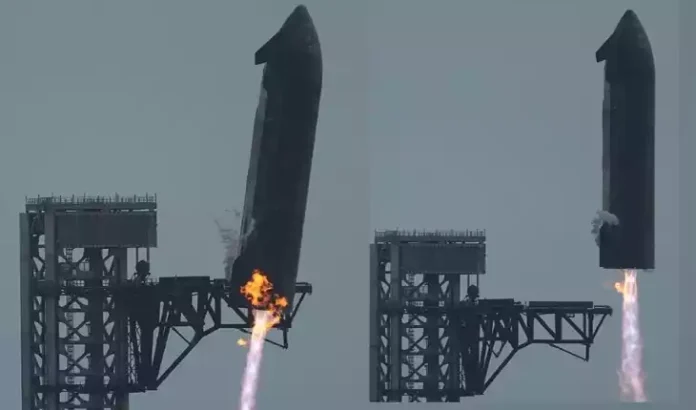

- SpaceX successfully caught its Starship spacecraft with launch tower arms after a 22.5-hour orbital mission.
- Starship completed approximately 14 Earth orbits and deployed 26 Starlink V3 satellites.
- The Super Heavy booster did not return for a tower catch and instead made an offshore landing in the Gulf of Mexico.
Washington: SpaceX has achieved a major milestone in rocket reusability after its Starship spacecraft successfully returned from orbit and was caught by the giant mechanical arms of its launch tower in Texas following a test flight.
The spacecraft completed its 15th integrated flight test, spending approximately 22.5 hours in space before returning to SpaceX’s Starbase facility in South Texas on Saturday, November 14. The successful recovery marked the first time a Starship upper stage had been caught by the launch tower after travelling to orbit.
The achievement is an important step towards SpaceX’s ambition of developing a fully reusable rocket system that can reduce launch costs and support more frequent space missions.
Starship Completes 22.5-Hour Mission
SpaceX launched its Starship system from the Starbase facility in Texas on Friday, November 13. The mission was designed to test the recovery of both major components of the rocket system: the Super Heavy booster and the Starship spacecraft.
After separating from the Super Heavy booster, Starship continued its journey into Earth orbit. During the mission, the spacecraft completed approximately 14 revolutions around Earth and deployed 26 next-generation Starlink V3 satellites.
It remained in space for more than 20 hours before beginning preparations for its return journey.
Giant Mechanical Arms Catch Starship
The most significant moment came when Starship returned to its launch site in Texas.
After completing its de-orbit manoeuvre, the spacecraft entered Earth’s atmosphere and carried out a controlled descent towards the launch tower. It then reignited its Raptor engines to perform the final landing manoeuvre.
Two enormous mechanical arms, popularly known as ‘Chopsticks’, successfully caught the spacecraft as it approached the tower.
The successful catch demonstrated that SpaceX could bring its Starship upper stage back to its launch site after an orbital mission, rather than allowing it to land in the ocean or be discarded.
Super Heavy Booster Recovery Attempt Unsuccessful
Although the Starship spacecraft was successfully recovered, the mission did not achieve its original objective of catching both rocket stages.
The Super Heavy booster did not return to the launch tower as planned. Following technical issues during its return sequence, it was diverted to an offshore landing location in the Gulf of Mexico.
As a result, the booster and spacecraft were not both recovered by the tower’s mechanical arms during the same mission.
Nevertheless, the successful recovery of the Starship upper stage represents a significant achievement for the company.
Major Step Towards Fully Reusable Rockets
SpaceX, led by Elon Musk, has been working to develop a fully reusable launch system capable of carrying crew and cargo into space.
The Starship system consists of two major components: the Super Heavy first-stage booster and the Starship upper-stage spacecraft. The company aims to recover and reuse both components after every mission.
If the technology becomes operational, it could significantly change the economics of space transportation by reducing the need to manufacture new rocket stages for every launch.
Starship is also central to SpaceX’s ambitions for future missions to the Moon and Mars. NASA has selected the spacecraft for its Artemis programme, which aims to return astronauts to the lunar surface.
However, important technical challenges remain, including reliable recovery of the Super Heavy booster, rapid refurbishment of the spacecraft and demonstrating in-orbit refuelling for lunar missions.
You May Like