
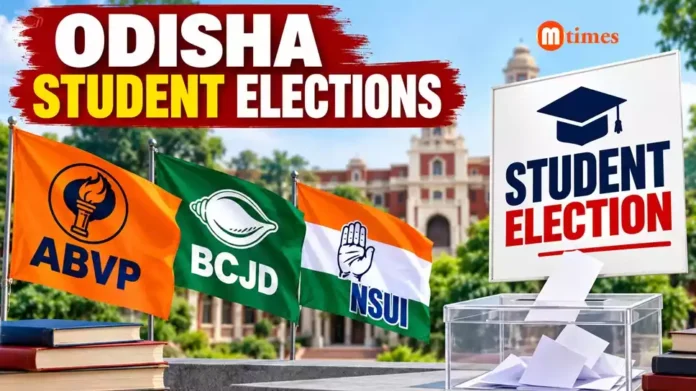

- ABVP secured eight of 13 university president posts and 11 general secretary positions, according to the supplied results.
- BCJD, NSUI and independent candidates also won important campus contests.
- Student elections took place across 346 colleges and 13 universities, with campus safety and infrastructure among the issues drawing attention.
Bhubaneswar: The Akhil Bharatiya Vidyarthi Parishad (ABVP) secured a significant share of leadership posts in Odisha’s student elections, winning eight of the 13 university president positions and 11 general secretary posts, according to the supplied results.
ABVP candidates also won in between 79 and 112 colleges, although the exact figure requires clarification. Other student organisations, including the Biju Chhatra Janata Dal (BCJD) and the National Students’ Union of India (NSUI), also secured important victories, alongside independent candidates.
The results cover contests across 346 colleges and 13 universities, with thousands of young voters aged 18 to 24 participating.
ABVP Records Wins Across Odisha Campuses
ABVP reported strong performances at several institutions, including a clean sweep at GM University and notable results at Utkal University.
The university president and general secretary positions were among the key posts contested. The results indicate that ABVP secured victories across multiple campuses, while other organisations retained support in selected institutions.
However, the exact college-level tally needs confirmation because the supplied figures give a range of 79 to 112 victories rather than a single final number.
BCJD, NSUI and Independents Also Win Key Posts
Despite ABVP’s performance, other student groups also secured important positions.
BCJD and NSUI recorded victories at selected campuses, including Rama Devi Women’s University and Ravenshaw University. Independent candidates also won in some contests.
The results varied by institution, highlighting the presence of multiple student organisations and independent candidates in Odisha’s campus politics.
A university-by-university breakdown would be needed to establish the precise distribution of posts among the competing groups.
Tejasvi Surya Calls Results a Verdict by Gen Z
BJP leader Tejasvi Surya described the outcome as a verdict by Generation Z, claiming that young voters had rejected what he called propaganda.
His statement represents a political interpretation of the results. The supplied information does not establish that voters chose candidates for this reason or provide survey evidence explaining their voting decisions.
Campus Issues Remain a Key Focus
Following the elections, attention is turning towards issues affecting students, including campus safety and infrastructure.
Student representatives are expected to face questions about the practical concerns of university and college communities. However, the supplied information does not specify the commitments made by individual winning candidates.
The elections provide an opportunity for student bodies to raise concerns about campus facilities, safety measures and the quality of the educational environment.
Thousands of Young Voters Participate
The contests involved 346 colleges and 13 universities, with thousands of voters aged 18 to 24 taking part.
The results offer a picture of student organisation activity across Odisha’s higher education institutions. However, the available information does not include the total number of eligible voters, voter turnout percentage or a complete list of winning candidates.
A detailed official result sheet would help establish the final seat totals and clarify the performance of each student organisation.
You May Like
Trending Searches Today |
- Odisha Student Elections: ABVP Secures Major Campus Wins
- PM-SETU Approves ₹1,194 Crore for ITI Clusters in Odisha
- Odisha CM Approves ₹56.55 Crore for Sarpanch And Naib Sarpanch Honorariums
- Reliance Welcomes Starlink as Elon Musk Questions India Entry
- Jio Platforms IPO: Price Band, Dates and Key Details
Amazon Online Shopping