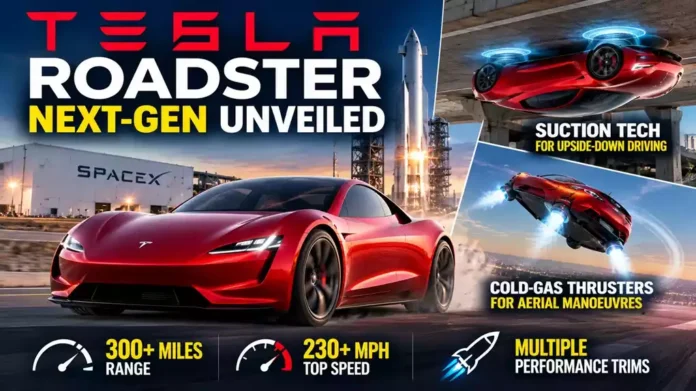

- Tesla’s next-generation Roadster is presented with proposed suction-based grip technology and cold-gas thrusters.
- The described variants include Performance, Thrust and an invite-only Rocket model, with production planned for 2028.
- The claimed range, speed and aerial manoeuvres require confirmation through final specifications and practical demonstrations.
Mumbai: Tesla’s next-generation Roadster has been presented with ambitious performance features, including suction-based grip technology for upside-down driving and cold-gas thrusters designed for aerial manoeuvres. The vehicle was showcased at a SpaceX facility in Texas, according to the supplied information.
Elon Musk highlighted the electric sports car’s proposed capabilities, which extend beyond conventional road performance. The plans include multiple versions of the Roadster, with production targeted for 2028.
However, the practicality of the more unusual features remains a subject of discussion, particularly whether aerial manoeuvres can translate into safe, useful real-world driving applications.
What Are the Tesla Roadster’s New Features?
The next-generation Roadster is presented as a high-performance electric vehicle with technologies intended to distinguish it from conventional sports cars.
One proposed feature uses suction technology to help the vehicle maintain contact with surfaces, potentially enabling upside-down driving. Musk also highlighted cold-gas thrusters designed to assist with aerial manoeuvres, including midair rotations.
These capabilities would represent a significant departure from standard electric vehicle engineering. Their real-world operation, safety requirements and availability will depend on the final production design and technical validation.
Tesla Roadster: Performance Variants and Specifications
The supplied information describes three proposed versions of the Roadster:
- Performance: A performance-focused model.
- Thrust: A version claimed to deliver acceleration in under one second.
- Rocket: An invite-only variant featuring the most ambitious proposed capabilities.
The vehicle is also described as targeting a driving range of more than 300 miles and a top speed exceeding 230 mph.
These figures should be treated as announced or projected specifications rather than independently verified production performance. Final specifications may change before the vehicle enters production.
How Could Cold-Gas Thrusters Work?
Cold-gas thrusters generate thrust by releasing pressurised gas. In principle, such a system can produce short bursts of force without conventional combustion.
For a road vehicle, integrating this technology would require careful engineering, including control systems, energy or gas storage, occupant protection and safeguards against unintended movement.
The supplied information does not establish the precise configuration of the Roadster’s thruster system or demonstrate how the proposed aerial manoeuvres would operate in production vehicles.
Can the Roadster Drive Upside Down?
The proposed suction technology is intended to provide grip on surfaces beyond those used by ordinary cars. Musk compared the concept to Spider-Man-like movement on overpasses and highlighted the potential for unusually high downforce.
However, upside-down driving would require reliable attachment, controlled movement and safeguards against sudden loss of grip. The practical limits of the technology cannot be determined from the announcement alone.
The proposed features therefore remain an engineering claim to assess against future demonstrations and production specifications.
Sam Altman’s Reaction and Questions About Practicality
OpenAI CEO Sam Altman reportedly described the Roadster as impressive, while some observers questioned whether the flying features would offer practical benefits to everyday drivers.
The debate centres on whether these technologies could provide meaningful engineering advantages or primarily serve as demonstrations of technical ambition.
For consumers, conventional considerations such as reliability, safety, range, charging, price and service support will remain important alongside any unusual performance features.
When Is the Tesla Roadster Expected to Enter Production?
Production is planned for 2028, according to the supplied information. The timeline and final specifications should be confirmed through official Tesla announcements as development progresses.
Until production vehicles and independently assessed demonstrations are available, the proposed top speed, range, acceleration and aerial capabilities should not be treated as guaranteed outcomes.
You May Like
Trending Searches Today |
- Ramayana Film: Cast, Music, Visuals and Release Details
- Tesla Roadster Unveiled With Thrusters and Flying Features
- Odisha Student Elections: ABVP Secures Major Campus Wins
- PM-SETU Approves ₹1,194 Crore for ITI Clusters in Odisha
- Odisha CM Approves ₹56.55 Crore for Sarpanch And Naib Sarpanch Honorariums
Amazon Online Shopping