
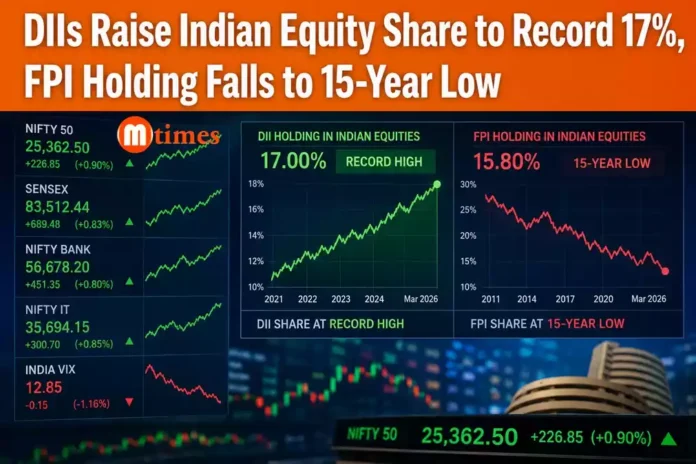

- Domestic institutional investors (DIIs) held a record 17% share of Indian equities by March 2026.
- Foreign portfolio investor (FPI) ownership fell to a 15-year low of 15.8%.
- SIP accounts rose to 10.45 crore, while average monthly SIP investments increased 25.8%.
MUMBAI: Domestic institutional investors strengthened their position in India’s stock market during 2025-26, increasing their share of Indian equities to an all-time high of 17%, according to the SEBI Annual Report 2025-26.
At the same time, foreign portfolio investor ownership declined to 15.8%, its lowest level in 15 years, highlighting the growing influence of domestic savings and institutional investment in India’s capital markets.
DIIs Invest ₹8.5 Lakh Crore in Indian Equities
According to SEBI, domestic institutional investors, including banks, development financial institutions, insurance companies, mutual funds and the National Pension System (NPS), recorded cumulative net investments of ₹8.5 lakh crore during 2025-26.
SEBI said domestic institutions acted as a counterbalance to foreign selling during a period of heightened global market volatility.
Consistent inflows through mutual fund Systematic Investment Plans (SIPs) played an important role in sustaining domestic investment.
SIP Investments Drive Domestic Market Participation
The SEBI report highlighted continued growth in India’s SIP ecosystem.
The number of SIP accounts increased by 3.9%, rising from 10.05 crore in 2024-25 to 10.45 crore in 2025-26.
Average net monthly SIP investments also increased significantly, climbing 25.8% from ₹13,052 crore to ₹16,413 crore.
The rising participation of retail investors through mutual funds has helped provide a steady source of domestic capital for Indian equities.
FPI Ownership Falls Amid Global Uncertainty
While domestic institutions continued buying, foreign investors reduced their exposure to Indian equities during the financial year.
Global factors such as:
- Geopolitical tensions in West Asia
- Elevated crude oil prices
- Rising US bond yields
- Shifting global investment flows
contributed to increased volatility and foreign capital outflows.
The changing ownership pattern indicates that India’s stock market is becoming increasingly supported by domestic institutional capital.
Nifty 50 Ends FY26 Lower After Record High
The Nifty 50 reached a record high of 26,328.6 in early January 2026 before geopolitical tensions and other global concerns triggered a market correction.
The index eventually ended the financial year 5.1% lower.
Despite the volatility and foreign selling, domestic institutional buying helped cushion the impact on Indian equities.
India Remains World’s Fifth-Largest Stock Market
SEBI said India continued to remain the world’s fifth-largest stock market despite the challenging market environment.
The country’s total market capitalisation stood at approximately ₹411.6 lakh crore at the end of 2025-26.
The record domestic institutional ownership highlights a significant structural shift in India’s equity market, with rising household savings and regular SIP investments increasingly providing a domestic counterweight to fluctuations in foreign capital flows.
You May Like
Trending Searches Today |
- Odisha Plans New ABADHA-Like Scheme for Puri Development
- IMD Thunderstorm Alert: 25 Odisha Districts on Watch
- BJD Says It Maintains Distance From BJP and Congress, Not Part of INDIA Bloc
- Puri Records 36.6°C as Heat and Humidity Persist, Coastal Odisha To Face Intense Heat
- West Bengal to Recruit 14,454 Government Post, To Provide Rs 50,000 For Unmarried Women
Amazon Online Shopping