

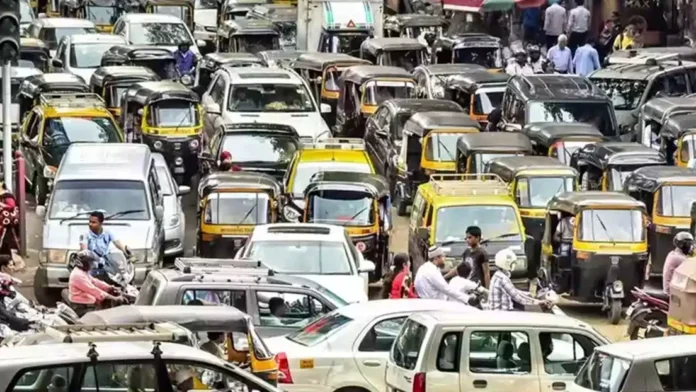


- Unpaid e-challans may affect access to several vehicle-related services.
- RC renewal, PUC certification, fitness certificates and ownership transfers could be affected by outstanding fines.
- Repeat traffic offenders may face action involving driving licence renewal and existing licences.
New Delhi: The Supreme Court has directed states and Union Territories to take stricter action against vehicles with unpaid e-challans, linking fine recovery with several important vehicle-related services.
The order was issued on September 28 in the road-safety case, S. Rajasekaran vs Union of India. The court made clear that issuing traffic challans alone is not enough and that authorities must also focus on recovering outstanding penalties.
Under the directions, motorists with unpaid traffic fines could face restrictions on services such as renewal of Registration Certificates (RC), issuance of duplicate RCs, changes to vehicle-owner addresses and fitness certificates.
The order also places the Pollution Under Control (PUC) certification process under greater scrutiny. PUC centres will not be permitted to issue certificates for vehicles where pending traffic fines have not been cleared, according to the source material.
What does the Supreme Court e-challan order change?
The key change is the stronger connection between unpaid traffic penalties and access to vehicle services.
Vehicles with outstanding e-challans are also to be blacklisted on the central Parivahan portal. This could prevent owners from selling their vehicles or transferring ownership until the outstanding dues are settled.
For motorists, this means an unpaid traffic fine could create problems beyond the original penalty. Vehicle documentation and related online services may also be affected.
The court has additionally directed authorities to take action against repeat traffic offenders. The source material states that the court referred to amended Rule 21(25) of 2026, under which five or more offences within a year are categorised as a public nuisance.
For such repeat offenders, authorities have been directed to suspend driving licence renewals and take steps concerning existing licences.
How much unpaid e-challan money is outstanding?
The scale of unpaid traffic fines was a key concern before the Supreme Court.
The court was informed that around ₹49,194.05 crore remained outstanding against e-challans issued across India. About ₹26,175.05 crore had reportedly been recovered.
The figures highlight the gap between detecting traffic violations and actually collecting the penalties imposed for those violations.
The latest directions therefore place greater emphasis on recovery rather than simply generating challans through digital enforcement systems.
Why is the e-challan system being strengthened?
India introduced e-challans to make traffic enforcement more technology-driven and reduce dependence on traditional paper-based processes.
CCTV cameras and automated systems can identify traffic violations and allow authorities to process penalties digitally. The Motor Vehicles Act, 1988, along with amendments made in 2019, has also strengthened penalties for several traffic offences.
However, a large number of challans have remained unpaid. Some cases have been transferred to virtual courts after the prescribed period, but the source material identifies the lack of an effective recovery mechanism as a continuing problem.
The Supreme Court’s latest approach seeks to connect payment compliance with essential vehicle services, making it more difficult for motorists to ignore outstanding penalties.
What happens to repeat traffic offenders?
The order takes a stricter approach toward motorists who repeatedly violate traffic rules.
In addition to action involving licence renewal, the court has directed authorities to conduct random vehicle checks. Vehicles found with unpaid challans may also face impounding under the directions described in the source material.
The broader objective is to make traffic enforcement effective after a violation has been detected, rather than treating the issuance of an e-challan as the end of the enforcement process.
What will states and transport authorities do next?
Implementation by states and Union Territories will determine how quickly the directions translate into action.
The Ministry of Road Transport and Highways (MoRTH) has been directed to create a public dashboard with monthly updates on state-wise electronic surveillance, enforcement devices and the relationship between violations detected and challans issued.
States and UTs have also been directed to implement the Standard Operating Procedure prepared by MoRTH on October 28, 2025, and comply with Section 136A of the Motor Vehicles Act, 1988.
The source material also refers to greater integration between systems such as VAHAN, SARATHI and e-challan services. This could strengthen the ability of authorities to identify outstanding penalties across different vehicle-related processes.
What about linking traffic fines with electricity bills?
The issue of recovering unpaid traffic fines through electricity bills requires an important clarification.
The source material states that the Supreme Court suggested that states could explore such recovery methods. It was not a direct order requiring traffic fines to be linked with electricity bills.
Therefore, motorists should not interpret the electricity-bill reference as an immediate nationwide rule.
The focus of the order remains the stronger recovery of unpaid traffic penalties and the enforcement of compliance through vehicle-related services.
What does the Supreme Court order mean for motorists?
For vehicle owners, the immediate takeaway is that ignoring an unpaid e-challan could have consequences beyond the original fine.
Pending penalties may affect access to certain vehicle services, PUC certification, ownership transfer and, in the case of repeat offenders, driving licence-related processes.
The Supreme Court’s directions also place greater responsibility on transport authorities to ensure that digital traffic enforcement results in actual recovery and compliance.
You May Like
Trending Searches Today |
- Supreme Court E-Challan Order: What Vehicle Owners Need to Know
- North Western Railway Apprentice Recruitment 2026: 2,008 Posts Announced
- Nandankanan Opens 36 Exotic Animals to Visitors
- Aadhaar Rules for NRI: What NRIs Need to Know
- KL Rahul Completes 10,000 International Runs In IND vs WI 3rd ODI 2026
Amazon Online Shopping
- Regulated density EPS concussion padding lined with specially treated anti allergic velveteen; Country of Origin: India
- Sport Type: Motorcycling

- ISI Certified Graphics Helmet. High Impact Resistant Thermoplastic shell
- Breathable Padding with Neck Protector and Extra Comfort for long Drives. Italian Design Hygienic Interior with Multi po…