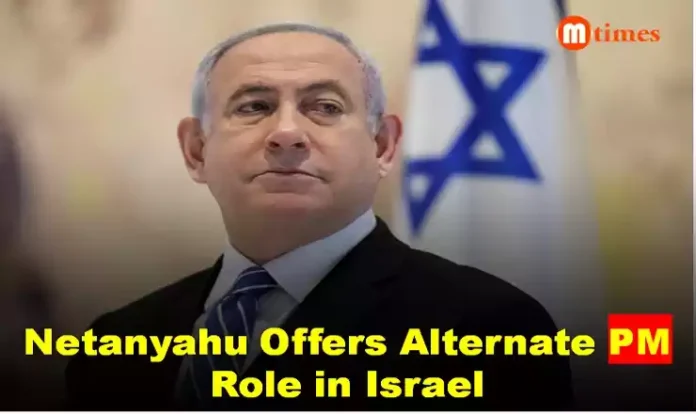

- Netanyahu has offered to let Gadi Eisenkot serve first as prime minister, with Netanyahu becoming alternate prime minister.
- The two leaders agreed to meet on November 29 to discuss the proposed unity government.
- Eisenkot must form a government by the deadline or seek a possible 14-day extension from President Isaac Herzog.
Jerusalem, November 29, 2026: Israeli Prime Minister Benjamin Netanyahu has offered to let political rival Gadi Eisenkot serve first as prime minister under a proposed national unity government, with Netanyahu initially taking the position of alternate prime minister.
The proposal, announced on November 28, comes amid efforts to form a new government following Israel’s inconclusive October 27 election. Netanyahu said he was prepared to set aside his preference to lead the government, citing what he described as serious security threats facing the country.
Under the proposed arrangement, Eisenkot would become prime minister first, while Netanyahu would serve as his deputy and alternate prime minister at the beginning of the parliamentary term.
Netanyahu Calls for Unity Government
Netanyahu said that as leader of the largest party, he believed he should ordinarily head a national unity government. However, he argued that the country’s security situation required political leaders to make compromises.
He called for immediate, genuine and accelerated negotiations between his Likud party and Eisenkot’s Yashar party.
The offer is also seen as an attempt to reach an agreement with Eisenkot as the latter works to assemble a coalition that could potentially replace Netanyahu’s government.
Eisenkot Responds to Netanyahu’s Proposal
Eisenkot said his party had been seeking serious negotiations with Likud for several weeks but had encountered what he described as refusal and delays.
He invited Netanyahu and his negotiating team to discussions on government principles and key policy issues.
According to Likud, the two leaders spoke by phone and agreed to meet on Sunday, November 29, at 10 am local time at the Dan Accadia Hotel in Herzliya.
The proposed meeting could provide an opportunity to assess whether the two parties can reach an agreement on forming a unity government.
Coalition Negotiations After Inconclusive Election
Israel’s October 27 election did not produce a clear parliamentary majority for either Netanyahu’s bloc or the opposition camp led by Eisenkot.
President Isaac Herzog tasked Eisenkot with forming the next government after 67 lawmakers recommended him for the assignment.
Eisenkot’s Yashar party has reached coalition agreements with the left-leaning Democrats and the right-wing Yisrael Beiteinu party. However, the potential alliance still needs additional parliamentary support to secure a majority.
Israel’s Knesset has 120 seats, and a government requires the support of at least 61 lawmakers to command a majority.
Eisenkot’s mandate to form a government expires on December 6. He can seek a one-time extension of up to 14 days from the President.
Opposition Leaders Question Netanyahu’s Offer
Netanyahu’s proposal has faced criticism from opposition leaders, who have questioned his willingness to honour a power-sharing agreement.
Former Prime Minister Yair Lapid dismissed the offer, accusing Netanyahu of breaking previous political agreements. Other opposition figures have urged Eisenkot to proceed with forming a government without Likud.
At the same time, Finance Minister Bezalel Smotrich backed Netanyahu’s proposal, describing it as a genuine attempt to establish a unity government.
The coming negotiations will determine whether the proposed arrangement can overcome political differences and secure sufficient support in the Knesset.
You May Like