

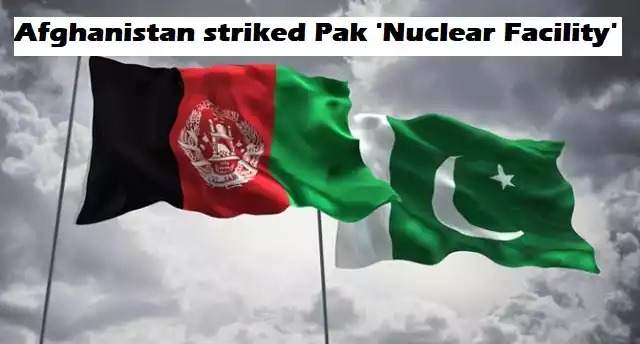

- Afghan forces reportedly struck a Pakistani nuclear facility and major military installations near Abbottabad
- Pakistan warns of an all out confrontation as airstrikes escalate across the Durand Line
- Global powers raise alarms over nuclear risk and regional instability
The Afghanistan Pakistan military escalation entered a dangerous new phase after Afghan armed forces reportedly struck a Pakistani nuclear facility alongside a major military base in Kakul village near Abbottabad. The strikes followed Pakistani air raids on Afghan territory that Kabul says killed civilians, pushing the confrontation beyond routine border clashes.
According to reports cited by Russian media, hundreds of casualties were transported to hospitals in Islamabad, underscoring the severity of the attack and its immediate security impact.
Why the Afghanistan Pakistan military escalation erupted now
The trigger lies in a rapidly escalating cycle of retaliation. Afghan officials say Pakistan launched overnight aerial incursions into Kabul, Kandahar, and Paktia, framing them as counterterrorism operations. Kabul rejects that narrative, calling the strikes deliberate aggression designed to deflect Pakistan’s internal security failures.
In response, Afghanistan says it launched precision airstrikes against high value Pakistani military targets, including the nuclear facility near Abbottabad, army cantonments in Nowshera, and military installations in Jamrud and Islamabad.
Nuclear facility strike raises strategic red lines
The reported targeting of a nuclear related facility marks a critical escalation. Even limited damage or symbolic targeting of such infrastructure significantly raises the stakes between two heavily militarised neighbours.
For Pakistan, any perceived threat to nuclear assets challenges core deterrence doctrine. That explains the unusually blunt warning from Defence Minister Khawaja Asif, who described the situation as an “all out confrontation” and said Pakistan’s restraint had reached its limit.
Second order effects are severe. Once nuclear linked sites enter the conflict narrative, de escalation becomes politically and strategically harder.
Civilian casualties harden retaliation logic
Civilian deaths have fueled public anger on both sides. Afghan officials cite the killing of women and children in Nangarhar and Paktika as justification for striking deeper into Pakistan. Islamabad denies intentionally hitting civilians but has not disputed the strikes themselves.
Each new casualty tightens domestic pressure on leaders, reducing space for compromise.
Global reaction to Afghanistan Pakistan military escalation
The United Nations, through Secretary General António Guterres, urged both sides to halt military action and protect civilians. Russia warned that continued clashes risk spiraling out of control, while China offered to mediate.
India sharply condemned Pakistan’s airstrikes on Afghan territory, describing them as attempts to externalise internal failures. These responses highlight growing international anxiety over instability between Afghanistan and Pakistan.
What comes next if escalation continues
If the current trajectory holds, the conflict risks shifting from retaliatory strikes to sustained military confrontation. Afghan officials say Pakistani aircraft continue to patrol Afghan airspace, signaling that rules of engagement are rapidly eroding.
The most dangerous second order effect is normalization. Once strikes on nuclear linked facilities and deep rear military sites become part of escalation, crisis control weakens dramatically.
For now, the Afghanistan Pakistan military escalation stands as South Asia’s most volatile flashpoint, with decisions in the coming days likely to define regional security for years.
Like this content? Sign up for our daily newsletter to get latest updates. or Join Our WhatsApp Channel
You May Like
Trending Searches Today |
- Jio Platforms IPO: Price Band, Dates and Key Details
- ED Raids 12 Premises in Odisha SI Recruitment Paper Leak Case In Odisha And West Bengal
- Odisha CM Launches 53 Industrial Projects Worth ₹39,383 Crore, To Generate 42,000 Jobs
- Mary Millben Alleges US Funding for CJP, Urges Youth to Protest
- Bhubaneswar Durga Puja Traffic Advisory: Routes, Diversions
Amazon Online Shopping


