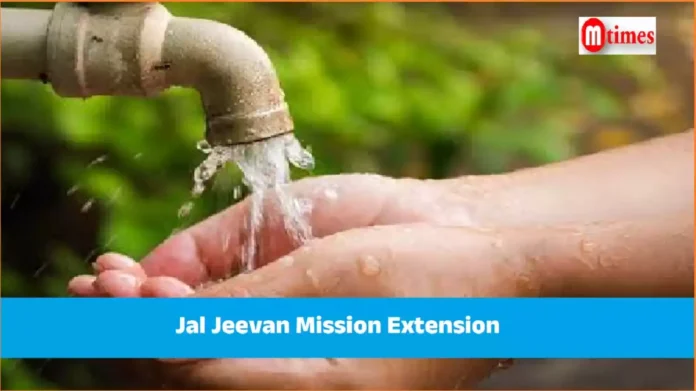

- The Union Cabinet approved the Jal Jeevan Mission extension to December 2028.
- The programme’s total outlay has increased to ₹8.69 lakh crore.
- The revamped initiative will shift focus from infrastructure creation to long term water service delivery and governance reforms.
New Delhi: The Jal Jeevan Mission extension 2028 has been approved by the Union Cabinet, significantly expanding India’s flagship rural drinking water programme. The decision increases the mission’s total outlay to ₹8.69 lakh crore, marking a major step toward ensuring reliable piped drinking water supply for rural households.
Union Minister Ashwini Vaishnaw said the restructuring aims to transform the programme from an infrastructure focused scheme into a service delivery model supported by stronger governance systems.
The data suggests the government is shifting its focus from building pipelines to ensuring sustainable water supply and long term maintenance of rural water infrastructure.
Jal Jeevan Mission Extension 2028: Higher Budget and Central Assistance
Under the revised programme, the Cabinet approved total central assistance of ₹3.59 lakh crore.
This represents a significant increase from the ₹2.08 lakh crore central allocation approved when the mission was launched in 2019.
The additional funding reflects an increase of ₹1.51 lakh crore in central support, aimed at strengthening rural water infrastructure and long term system management.
What the policy shift indicates is that the government is now prioritising service reliability, governance systems and community participation rather than only infrastructure expansion.
JJM 2.0 Introduces Digital Governance System
The restructured programme, often referred to as JJM 2.0, will introduce a national digital framework called Sujalam Bharat.
Under this system:
- Every village will receive a unique “Sujal Gaon” service area identification number
- The entire drinking water supply chain will be digitally mapped from source to household tap
This digital tracking framework is expected to improve monitoring, transparency and operational efficiency in rural water supply systems.
Community Participation Through Jal Arpan and Jal Utsav
The programme will also introduce new community participation mechanisms.
Under the Jal Arpan initiative, Gram Panchayats and Village Water and Sanitation Committees will be involved in verifying and taking ownership of water supply schemes.
A village will declare itself as achieving “Har Ghar Jal” status only after confirming that proper operation and maintenance systems are functioning.
Also Read | PM Modi Launches ₹16,000 Cr Projects in Kerala, TN
Another initiative called Jal Utsav will be organised annually to review water infrastructure and encourage community participation in maintaining drinking water systems.
Progress of Jal Jeevan Mission Since 2019
Launched in 2019 by the Ministry of Jal Shakti, the Jal Jeevan Mission aims to provide functional household tap connections to all rural households.
According to government data:
- In 2019, only 3.23 crore households (about 17 percent) had tap water connections
- Since then, over 12.56 crore additional households have been covered
Currently, out of 19.36 crore rural households, about 15.80 crore households (81.61 percent) now have access to tap water.
Social and Economic Impact of the Mission
Officials say the mission has produced wider benefits beyond drinking water access.
Research cited by the government indicates:
- Nearly 9 crore women have been freed from daily water collection tasks
- Health outcomes have improved in rural communities
- Time savings have supported education and economic activity
Estimates by the World Health Organization suggest improved access to clean water has helped prevent hundreds of thousands of diarrhoeal deaths.
Government’s Goal for 2028
Under the extended programme, the government aims to provide tap water connections to all 19.36 crore rural households by December 2028.
The mission will also ensure that every Gram Panchayat achieves verified Har Ghar Jal status, supported by sustainable water sources and long term operation systems.
The data suggests the next phase of the mission will focus on creating a reliable rural water utility model, aligned with India’s broader vision of becoming a developed nation by 2047.
You May Like
Trending Searches Today |
- Odisha Appropriation Bill 2026-27 Passed: ₹3.10 Lakh Crore Budget Cleared Amid Opposition Walkout
- Odisha CAG Report PSU Losses Profit: Growth Masks Deep Structural Problems
- April 1, 2026 Daily Horoscope: Love, Money, Career Signals
- Modi Russia Visit 2026 Summit: Moscow Awaits PM for Key Bilateral Talks
- Odisha Elephant Attacks Deaths Data: 443 Lives Lost, 264 Elephants Dead in 3 Years
Amazon Online Shopping