

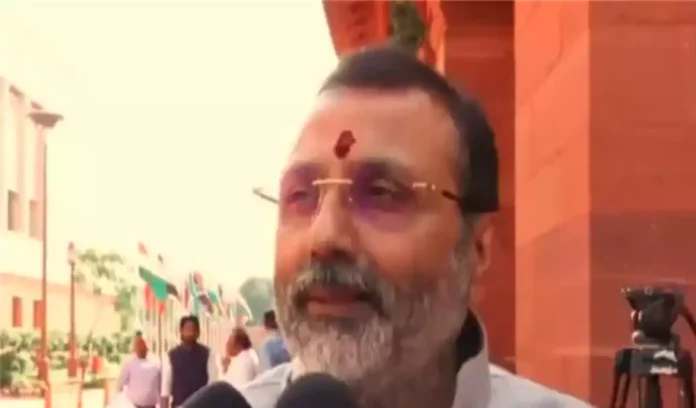


- BJP MP Nishikant Dubey attacked the Congress leadership, specifically naming Mallikarjun Kharge and Rahul Gandhi.
- The remarks followed Kharge’s controversial response to an audience member at a Patna event on October 25.
- BJP and Congress leaders have offered competing interpretations of the incident, extending the dispute over political language and public conduct.
New Delhi: Bharatiya Janata Party (BJP) MP Nishikant Dubey on Monday criticised the Congress party and its top leadership, describing the party in disparaging terms and targeting Congress president Mallikarjun Kharge and Leader of the Opposition Rahul Gandhi.
Dubey’s remarks came amid a political controversy over Kharge’s comments about Prime Minister Narendra Modi during a public event in Patna on Sunday. The BJP has accused the Congress president of using inappropriate language, while Congress leaders have defended his response as part of an exchange with an audience member.
Speaking to reporters, Dubey argued that political disagreements should not lead to personal remarks about a sitting prime minister or members of the prime minister’s family.
Nishikant Dubey Recalls Opposition’s Defence of Indira Gandhi
During his remarks, Dubey referred to the period following the 1971 Bangladesh War, recalling how opposition leaders Atal Bihari Vajpayee and Lal Krishna Advani had defended then Prime Minister Indira Gandhi against derogatory comments reportedly made by American leaders Henry Kissinger and Richard Nixon.
According to Dubey, those leaders had placed national dignity above political differences when responding to remarks directed at the prime minister.
He argued that political parties should maintain similar standards of conduct while criticising leaders from rival parties.
Dubey alleged that the language being used in the current controversy reflected a departure from that tradition. These comments were part of his political criticism of the Congress leadership.
Kharge’s Patna Remark Triggers Political Row
The controversy began on October 25 during an event in Patna commemorating the birth anniversary of Bihar’s first chief minister, Shri Krishna Singh.
While addressing the gathering, Kharge responded to an audience member who said that Prime Minister Modi would not leave power. Kharge replied with the Hindi phrase, “Modi ka baap bhi jayega.”
The remark drew criticism from BJP leaders, who accused the Congress president of crossing the limits of political discourse.
Congress leaders, meanwhile, argued that the statement was made in response to an audience member’s provocation. The exchange has since become the subject of a wider political dispute.
Dubey Criticises Congress Over Electoral Performance
Dubey also linked his criticism to the Congress party’s electoral record, claiming that repeated election defeats had affected its leadership.
He alleged that Congress leaders were struggling to accept their political setbacks and predicted that the party would remain in opposition for years.
These were Dubey’s political assertions and assessments, rather than independently established conclusions about the party’s future electoral performance.
He reiterated his criticism of the Congress leadership, naming Kharge and Rahul Gandhi while accusing the party of moving away from constructive political debate.
BJP and Congress Exchange Further Criticism
The controversy has prompted criticism from several BJP leaders, with some demanding an apology from Kharge over his remarks concerning the prime minister’s late father.
Congress leaders have challenged the BJP’s criticism, arguing that standards of political language should be applied consistently across parties. Priyank Kharge, the Congress president’s son and a Karnataka minister, has defended his father’s response by referring to the circumstances of the exchange.
The dispute has expanded beyond the original Patna event, with leaders from both parties using public statements to challenge their political opponents.
The episode has renewed debate about the language used by political leaders and the distinction between forceful criticism and personal attacks.
You May Like