
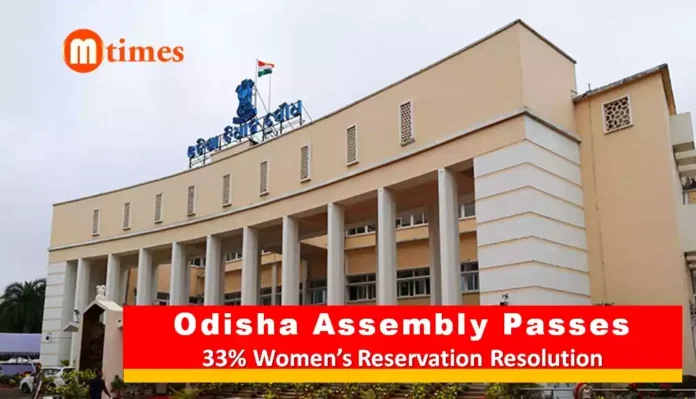

- Odisha Assembly passes 33% Women’s Reservation resolution
- Special session lasted 14 hours and 45 minutes
- Political and economic empowerment were both central themes
BHUBANESWAR: The landmark move where the Odisha Assembly Passes 33% Women’s Reservation resolution has positioned the state at the forefront of India’s gender representation debate, with legislators formally urging the immediate implementation of the Nari Shakti Vandan Adhiniyam.
After one of the longest sittings in Odisha Legislative Assembly history, the resolution became more than symbolic support, it emerged as a direct call to accelerate women’s political inclusion instead of delaying it behind census and delimitation timelines.
This matters nationally because the debate is no longer about whether women deserve equal representation, but how quickly democratic institutions are willing to deliver it.
Odisha Assembly Passes 33% Women’s Reservation Resolution: Why This Resolution Matters
The urgency is rooted in representation decline.
Odisha currently has only 11 women MLAs, down from 18 in the previous Assembly.
That drop gave sharper relevance to the debate, exposing the widening gap between women’s population share and their legislative presence.
While women form nearly half of India’s population, their representation in lawmaking bodies remains significantly lower, making the Assembly’s move a broader statement on democratic imbalance.
CM Mohan Charan Majhi Frames Representation as Structural Reform
Mohan Charan Majhi used the debate to argue that women’s reservation is not merely a policy issue, but a structural correction.
By backing immediate execution of the 2023 Women’s Reservation framework, Majhi positioned Odisha as a state pushing for practical implementation over procedural delay.
His political message was clear, democracy cannot claim inclusivity while women remain underrepresented.
Opposition Support Came With Timing Concerns
The BJD and Congress backed the principle of reservation, but questioned delays tied to the post-2026 census and delimitation.
Their concern was strategic, delayed implementation could weaken reform momentum and postpone real representation gains.
This shifts the conversation from legislative approval to execution urgency.
Beyond Quotas: Odisha’s Financial Push for Women
The debate also linked representation with economic agency.
The state spotlighted ₹1.22 lakh crore in women-focused budget allocation, a 30 percent increase in gender-based spending.
Programs such as Subhadra Yojana, Lakhpati Didi, and Mukhyamantri Kanya Bibaha Yojana were presented as pillars of a wider empowerment framework.
This approach suggests Odisha is attempting to combine political access with financial mobility.
Second-Order Effects on Indian Politics
If momentum builds, this resolution could influence:
Political ticket distribution, candidate strategy, women-led grassroots leadership, and national pressure on implementation timelines.
The Assembly’s call for all parties to voluntarily reserve at least one-third of election tickets for women before legal enforcement could also reshape electoral competition.
Why This Could Become a Political Benchmark
By holding one of its longest debates on women’s democratic participation, Odisha has elevated gender representation into a central governance issue.
That sends a broader message, women’s reservation is increasingly becoming a measure of political seriousness, not just policy symbolism.
The moment Odisha Assembly Passes 33% Women’s Reservation is more than a legislative resolution, it reflects rising demand for faster democratic correction.
Odisha has effectively raised the pressure on India’s political system to convert constitutional promise into visible representation.
The next test is whether this momentum produces implementation, or becomes another delayed reform with strong headlines but slow results.
Also Read | Odisha Matric Result 2026: 95.33% Pass as 5,19,251 Students Clear BSE Odisha HSC Exams
You May Like
Trending Searches Today |
- Kolkata Durga Puja Stampede Kills 19, 25 Injured; CM Announces Rs 25 lakh Aid and Government Jobs
- Air India and Air India Express Suspends Jeddah, Riyadh and Dammam Flights
- FSSAI Proposes Ban on Added Sucrose and Fructose in Infant Foods
- Ramayana Film: Cast, Music, Visuals and Release Details
- Tesla Roadster Unveiled With Thrusters and Flying Features
Amazon Online Shopping