
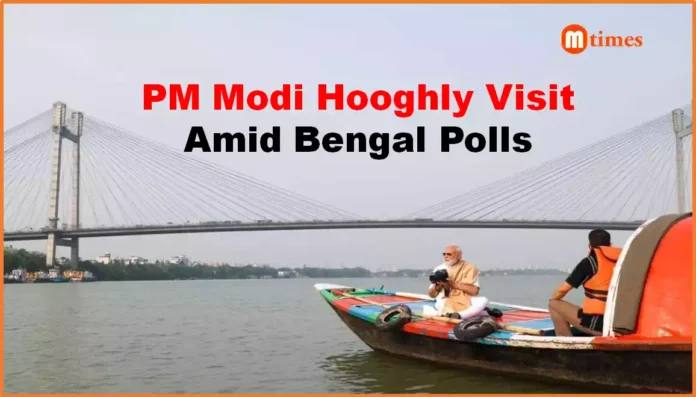

- PM Modi takes boat ride on Hooghly River, emphasizes Bengal’s cultural roots
- Reaffirms commitment to West Bengal’s development during election season
- Visit comes amid record voter turnout and intense BJP vs TMC battle
Kolkata: The PM Modi Hooghly river visit camera in hand in Kolkata comes at a politically charged moment, combining cultural symbolism with strategic election messaging. Prime Minister Narendra Modi spent time along the riverbanks, highlighting the spiritual significance of the Ganga while reinforcing his government’s focus on West Bengal’s development.
The visit is being seen as more than a routine stop. It reflects a calibrated effort to connect with local sentiment while strengthening political outreach ahead of upcoming polling phases.
Cultural Symbolism at the Heart of PM Modi Hooghly River visit Camera in Hand
During his time at the Hooghly River, Narendra Modi emphasized the deep emotional and cultural connection Bengalis share with the Ganga.
He described the river as central to Bengal’s identity, calling it a symbol of civilisation and spiritual continuity. The Prime Minister also spent quiet moments by the river, framing the visit as an expression of gratitude.
Such gestures often carry political weight, especially in states where cultural identity plays a significant role in voter perception.
Ground Connect: Interaction with Locals
The Prime Minister interacted with boatmen and morning walkers during his visit, acknowledging their work ethic and daily struggles.
These interactions serve a dual purpose. They project accessibility and grassroots engagement while reinforcing the narrative of a leader connected to ordinary citizens.
Political Context: Elections Intensify in West Bengal
The visit comes just after the first phase of West Bengal Assembly elections, which recorded a remarkable turnout of 92.59%.
The contest is primarily between the All India Trinamool Congress led by Mamata Banerjee and the Bharatiya Janata Party.
With high voter participation and strong campaigning on both sides, the elections are shaping up to be a tightly contested battle.
Campaign Strategy and Political Messaging
Following his visit, Narendra Modi intensified campaigning, addressing rallies and targeting the ruling party.
At a rally in Krishnanagar, he used a light remark about eating jhalmuri to criticize the opposition, signaling a mix of humor and political attack in campaign messaging.
This approach reflects a broader strategy, combining cultural outreach, direct voter engagement, and sharp political positioning.
What This Means for the Election Outcome
High turnout and aggressive campaigning suggest that voter sentiment remains fluid. Symbolic visits like the Hooghly outing can influence perception, especially among undecided voters.
The second phase of polling on April 29 will be critical in shaping momentum, while results on May 4 will determine the final outcome.
In the larger picture, the visit underscores how cultural narratives and political strategy are increasingly intertwined in India’s electoral landscape.
Also Read | West Bengal Voter Turnout 2026 Surges to 89.93%, Leads Nationwide Poll Participation
You May Like
Trending Searches Today |
- Delhi CM Orders Probe Against JE, Announces ₹5 Lakh Aid to Animal Activist Jagriti Mishra
- PM Modi Inaugurates ₹169-Crore RBI Data Centre and Cybersecurity Institute in Odisha
- Cyclone Arnab: Red Alert Issued For Six Districts, Odisha CM Reviews Preparedness, Fishermen Warned
- PM Modi to Inaugurate RBI Data Centre in Bhubaneswar on October 25
- India Beat New Zealand by Four Wickets in 2nd T20I, Take 2-0 Series Lead
Amazon Online Shopping