
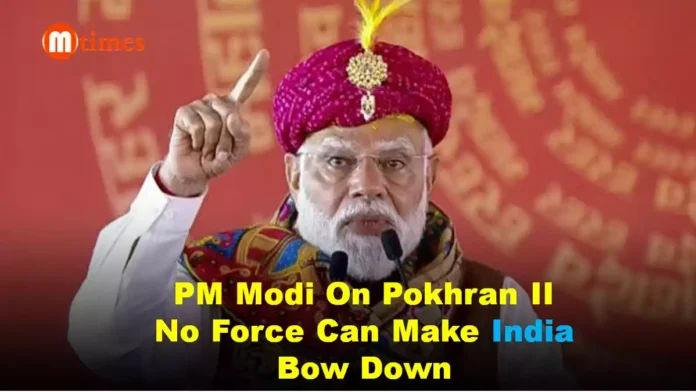

New Delhi: Prime Minister Narendra Modi on Wednesday paid tribute to the legacy of the Pokhran II nuclear tests, saying the operation demonstrated India’s refusal to surrender to international pressure.
In a post on X marking the anniversary of the tests, Modi said the 1998 operation showed the world that “no force can make India bow down,” despite widespread diplomatic and economic pressure faced by the country after the tests.
The remarks revived focus on one of the most defining moments in India’s strategic history, when the country openly declared itself a nuclear weapons power.
Pokhran II Nuclear Tests Changed India’s Global Position
Pokhran-II, also known as Operation Shakti, involved a series of five underground nuclear tests conducted at the Pokhran Test Range in Rajasthan on May 11 and May 13, 1998.
The tests were carried out under the leadership of former Prime Minister Atal Bihari Vajpayee and included both fission and thermonuclear devices.
The operation immediately transformed India’s strategic standing and formally established the country as a declared nuclear weapons state.
At the time, several Western nations, including the United States and Japan, imposed sanctions and diplomatic restrictions on India in response to the tests.
However, the Vajpayee government defended the decision as necessary for national security amid an increasingly volatile regional environment.
Why Pokhran II Remains Strategically Important
The Pokhran tests became a turning point in India’s defence and foreign policy framework.
They laid the foundation for India’s nuclear doctrine, including the principles of “credible minimum deterrence” and “no-first-use.”
The second-order effect of Pokhran II extended beyond military capability. It accelerated India’s emergence as an independent strategic power willing to pursue long-term national security goals despite global pressure.
Over the following years, India gradually rebuilt diplomatic ties with major powers and eventually secured wider international acceptance as a responsible nuclear state.
Many analysts now view Pokhran II as a moment that reshaped India’s geopolitical confidence and strategic autonomy.
PM Modi Continues to Invoke Vajpayee’s Legacy
Narendra Modi has frequently referenced Pokhran II and Vajpayee’s leadership in speeches related to national security and self-reliance.
For the BJP, the nuclear tests remain closely linked to themes of strong leadership, sovereign decision-making and national pride.
The anniversary also serves as a reminder of how India balanced security priorities with diplomatic recovery after facing international isolation in the late 1990s.
Today, Pokhran II is widely remembered not only as a military milestone but also as a defining statement of India’s strategic independence on the global stage.
Also Read | IMD Issues 5-Day Odisha Rain Warning With Thunderstorm Alert
You May Like
Trending Searches Today |
- Jio Platforms IPO Allotment Status 2026: How to Check Online on KFintech, BSE and NSE
- Nishikant Dubey Attacks Congress, Targets Mallikarjun Kharge and Rahul Gandhi
- Union Minister Rajnath Singh Criticises Kharge Over Remarks on PM Modi’s Late Father
- Jammu Fire Destroys Around 40 Shops Near Railway Station
- Odisha on High Alert as Cyclone Arnab Threatens Southern Districts
Amazon Online Shopping