
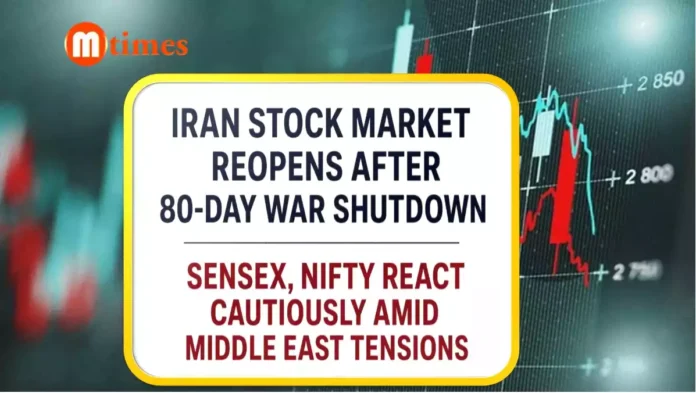

- Iran’s stock market reopened after nearly 80 days of shutdown during the US-Israel conflict.
- Indian benchmark indices Sensex and Nifty traded cautiously amid global uncertainty.
- Rising crude oil prices and Strait of Hormuz risks continue to pressure financial markets.
Mumbai/Dubai: Tehran Stock Exchange reopened on May 19 after remaining shut for nearly 80 days during the conflict involving the United States and Israel, marking one of the longest wartime market suspensions in recent history.
Iran had frozen trading on February 28 following missile strikes and escalating regional tensions, aiming to prevent panic selling and protect retail investors during severe economic uncertainty.
The reopening is being closely watched globally because the broader Middle East crisis continues to influence oil prices, investor sentiment and equity markets across Asia, including India.
Iran Stock Market Reopening Signals Fragile Recovery
Trading resumed gradually in shares, equity funds and equity-linked derivatives, with authorities extending market hours to help companies disclose financial impacts linked to the conflict.
Iran’s financial regulator said the suspension was necessary to prevent emotionally driven selling that could have triggered a major collapse in household savings.
The second-order effect of the prolonged closure may continue to impact investor confidence because businesses across sectors such as petrochemicals, steel and mining reportedly suffered operational disruptions during the conflict.
Why Iran Closed the Tehran Stock Exchange
Iran’s Securities and Exchange Organization said the unprecedented suspension was necessary to stop emotionally driven selling that could have triggered a severe financial crash.
Officials feared millions of retail investors would rush to liquidate holdings amid war fears, potentially wiping out household savings across the country.
According to reports, SEO deputy Hamid Yari said the closure aimed to:
- Protect investor assets
- Prevent emotional market behaviour
- Ensure transparent trading conditions
- Allow companies to assess losses
The shutdown also coincided with widespread internet restrictions and communication blackouts across Iran, which disrupted financial transactions and access to trading systems.
Conflict Severely Impacted Iran’s Economy
Before the war escalated, Iran’s benchmark TEDPIX index had surged to record highs near 4.5 million points at the beginning of 2026.
However, the market later came under heavy pressure after nationwide protests intensified and authorities imposed a prolonged internet blackout.
Missile strikes reportedly damaged industrial facilities and business hubs in cities including:
- Tehran
- Isfahan
- Qom
Key sectors affected reportedly included petrochemicals, steel and mining industries.
Global Markets Watching Strait of Hormuz Risks
The reopening of Iran’s stock market comes as global investors remain highly focused on instability in West Asia.
One of the biggest concerns continues to be the Strait of Hormuz, which handles nearly 20 percent of global petroleum consumption and major LNG exports daily.
Analysts warn that any further escalation could:
- Push oil prices even higher
- Increase freight and insurance costs
- Intensify global inflation
- Disrupt energy supply chains
With energy markets already under pressure, Iran’s economic recovery and financial stability remain closely tied to the broader geopolitical situation across the Middle East.
How Sensex and Nifty Reacted to Iran Market Reopening
Indian equity markets reacted cautiously amid continuing uncertainty in West Asia and rising crude oil prices.
BSE Sensex and Nifty 50 witnessed volatile trading as investors assessed the geopolitical risks linked to the region.
Market experts said concerns over:
- Crude oil supply disruptions
- Inflationary pressure
- Weakening rupee
- Higher import costs
- Foreign investor outflows
continued to weigh on investor sentiment.
Oil-sensitive sectors including aviation, paints, logistics and automobile stocks remained under pressure because sustained high crude prices directly increase operational costs.
However, energy and oil exploration companies saw selective buying interest as investors anticipated stronger earnings from elevated oil prices.
Strait of Hormuz Remains Key Market Risk
One of the biggest concerns for global financial markets remains the situation around the Strait of Hormuz.
The narrow waterway handles nearly 20 percent of global petroleum consumption and a significant portion of LNG exports every day.
Any escalation in the region could:
- Push global crude prices sharply higher
- Increase shipping and insurance costs
- Intensify inflation worldwide
- Trigger further market volatility
Indian markets remain particularly sensitive because India imports a large share of its crude oil requirements.
Global Investors Watching Middle East Closely
The reopening of Iran’s stock market does not necessarily signal stability returning to the region.
Analysts believe financial markets worldwide will continue reacting sharply to developments involving:
- Iran-US tensions
- Israel’s military actions
- Energy infrastructure security
- Maritime trade routes
For investors, the Middle East conflict has now evolved from a geopolitical issue into a major economic risk capable of influencing inflation, currency markets and global growth expectations simultaneously.
Also Read | Rahul Gandhi Targets PM Modi Over Adani Case
You May Like
Trending Searches Today |
- IIIT Ranchi Student Found Dead in Hostel, Students Protest
- Odisha Police Tighten Security Ahead of October 15 Student Elections
- US Eases Russian Diesel Sanctions Until April 2027
- Mahalaya Begins Durga Puja Countdown Across India
- Odisha Plans New ABADHA-Like Scheme for Puri Development
Amazon Online Shopping