
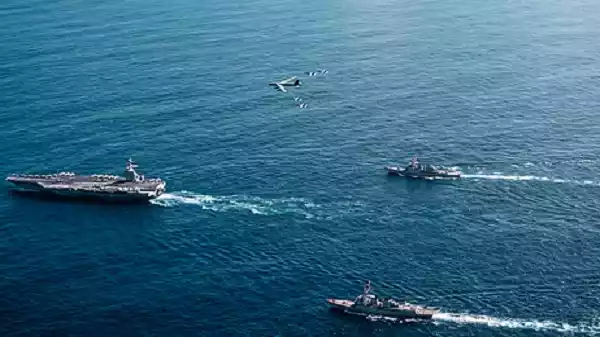

- The USS Gerald R. Ford is being redirected from the Caribbean to West Asia amid stalled US-Iran nuclear talks
- The move follows high-level discussions between President Trump and Israeli Prime Minister Netanyahu
- Gulf states warn that escalation could destabilize the wider Middle East and derail diplomacy
Washington: The USS Gerald R. Ford redeployment marks a major shift in US military posture as President Donald Trump orders America’s most advanced aircraft carrier toward West Asia, signaling renewed pressure on Iran during fragile nuclear negotiations. US officials say the carrier strike group, previously operating in the Caribbean, will now reinforce an already formidable American naval presence near Iran at a time of deep diplomatic uncertainty.
USS Gerald R. Ford redeployment strengthens US naval dominance in West Asia
The decision will place USS Gerald R. Ford alongside the USS Abraham Lincoln and its escort vessels, creating a dual-carrier posture rarely seen outside periods of acute crisis. Together, the two strike groups bring enhanced airpower, missile defense, and rapid strike capability, underscoring Washington’s intent to maintain military leverage over Iran.
US defense officials describe the redeployment as a rapid refocus on the Middle East, aligning with a broader buildup that already includes guided-missile destroyers, intelligence platforms, and surveillance aircraft. According to reporting by Axios, the move is designed to remind Tehran that diplomatic talks are unfolding under the shadow of overwhelming force.
USS Gerald R. Ford redeployment follows Trump–Netanyahu talks
President Trump’s order came shortly after consultations with Benjamin Netanyahu, reflecting close coordination between Washington and Israel on Iran policy. The timing also follows weeks of inconclusive indirect negotiations with Tehran over its nuclear program, which US officials privately admit have yielded no tangible progress.
Also Read | IAF–RTAF Joint Air Combat Exercise Enhances Defence Cooperation in Indian Ocean
Publicly, Trump has intensified rhetoric, warning Iran that failure to reach an agreement within weeks could result in what he described as “very traumatic” consequences. At the same time, the White House has emphasized that sustained military pressure is essential to any successful diplomatic outcome, particularly as Iran faces internal protests, economic strain, and political unrest.
Iran rejects talks under military threat as regional anxiety grows
Iranian leaders have repeatedly stated that they will not negotiate while facing military coercion, rejecting discussions that extend beyond nuclear limitations or occur alongside visible threats. Tehran argues that carrier deployments undermine trust and make meaningful dialogue impossible, a position echoed by critics who fear escalation could derail diplomacy altogether.
Gulf Arab states have also voiced concern, warning that any direct confrontation could ignite a wider regional conflict. With tensions already elevated by the Israel–Hamas war and unrest inside Iran, several Gulf governments have reportedly signaled they would not allow their territory to be used for launching attacks against Iran, complicating US operational planning.
Strategic transit highlights balance between diplomacy and deterrence
The Ford’s journey from the Caribbean to West Asia is expected to take several weeks, involving passage through critical maritime chokepoints before joining the existing US naval force. While the deployment enhances deterrence and reassures allies, it also raises the stakes at a moment when negotiations remain uncertain.
As Washington attempts to balance diplomatic engagement with a show of strength, the redeployment underscores a central reality of US policy: in today’s Middle East, diplomacy and military power are advancing in parallel, even as the risk of miscalculation continues to grow.
You May Like
Trending Searches Today |
- RCB vs SRH IPL 2026 Preview Batting Fireworks Likely in Chinnaswamy Opener
- Odisha Rain Alert IMD Thunderstorm Warning: 7 Days of Lightning, Gusty Winds Ahead
- March 28 2026 Daily Horoscope: Focus, Money, Love Signals
- Petrol Diesel Excise Duty Cut India: Govt Slashes Taxes to Tackle Oil Crisis
- Orissa High Court Penalty Delay Order: Officer Fined ₹1 Lakh for Ignoring Court Timeline
Amazon Online Shopping