
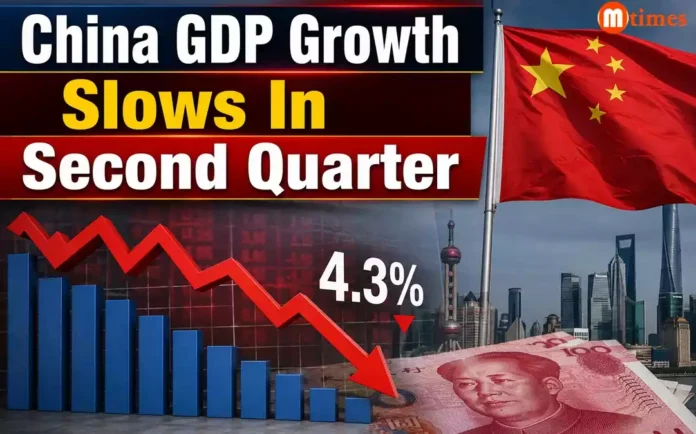

- China’s GDP growth slowed to 4.3% in the second quarter.
- Weak domestic demand and a sharp fall in investment weighed on economic activity.
- Strong exports continued to support growth but increased trade tensions with the European Union.
Beijing: The China GDP growth rate slowed to 4.3 percent in the second quarter of the year, reflecting mounting pressure from weak domestic demand and declining investment. While exports continued to provide support, economists say the imbalance between external trade and domestic consumption is becoming more pronounced, increasing challenges for the world’s second-largest economy.
The latest figures suggest that China’s recovery remains uneven, with consumer spending and investment failing to match the strength of its export sector. The trend has also intensified concerns over the country’s long-term growth model and its impact on global trade.
China GDP Growth Hit by Falling Investment and Weak Consumption
A report by the Mercator Institute for China Studies (MERICS) said fixed-asset investment was the biggest factor behind the slowdown. Real estate investment recorded its steepest first-half decline on record, while spending also weakened in infrastructure, education, healthcare and construction.
The report attributed much of the slowdown to financial pressures on local governments, which traditionally finance a large share of public infrastructure projects. Limited fiscal resources have reduced investment across several sectors, weakening overall economic activity.
Consumer confidence also remained subdued. Domestic car sales declined sharply in June, highlighting softer household spending and reinforcing concerns that domestic demand is not recovering at the pace needed to sustain stronger economic growth.
Exports Continue to Support China’s Economy
Despite weakness in the domestic market, China’s external trade remained resilient. Exports posted strong growth in June, led by high-tech products, while imports also increased in value.
However, analysts noted that higher import values were driven largely by rising prices rather than a significant increase in import volumes. This indicates that domestic demand remains relatively weak even as export-oriented industries continue to expand.
The report also said China’s growing dependence on exports is likely to keep trade tensions with the European Union elevated. European policymakers have become increasingly concerned about the impact of Chinese exports and industrial policies on regional markets, prompting a reassessment of trade protection measures.
China GDP Growth Faces Structural Challenges
Analysts believe stronger domestic consumption and private investment will be essential if China is to achieve sustainable economic growth in the coming years. However, meaningful reforms to increase household spending are expected to take time, making exports the primary driver of growth in the near term.
As global economic conditions remain uncertain, China’s ability to rebalance its economy and reduce dependence on exports is expected to remain one of the key issues shaping international trade and economic policy.
You May Like
Trending Searches Today |
- Banks Open Today Ahead of Three-Day Nationwide Strike
- Ishwar Chandra Vidyasagar: Social Reformer Remembered On His 207th Birth Anniversary
- OSSTET 2026 Exam on September 30, Download Admit Card, Check Details
- Odisha Old Age Pension Arrears to Be Paid by October
- Naveen Patnaik Demands CEC Resignation, SIR Review
Amazon Online Shopping