
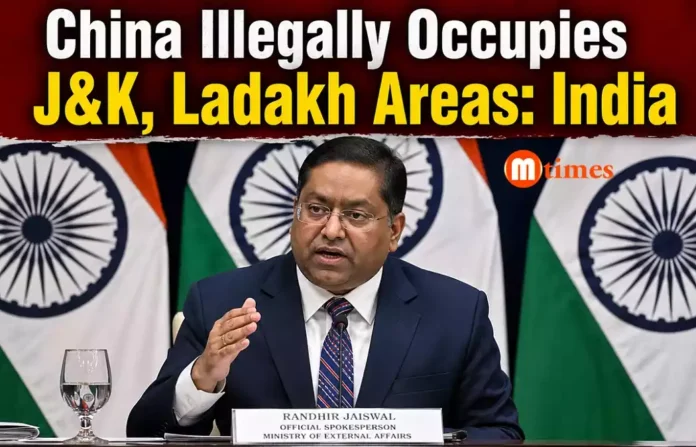

- India said China has illegally occupied parts of Jammu and Kashmir and Ladakh since 1963.
- The MEA reiterated its objection to Chinese infrastructure projects in Indian territory.
- External Affairs Minister S. Jaishankar said peace along the border remains essential for normal India-China ties.
NEW DELHI: The India China sovereignty issue came into sharp focus on Friday after the Ministry of External Affairs (MEA) stated that Beijing has been in illegal occupation of Indian territories in Jammu and Kashmir and Ladakh since 1963. The Centre said India has consistently respected China’s sovereignty, while maintaining that it has every right to raise concerns over Chinese activities in areas New Delhi considers its own.
The remarks highlight that territorial issues remain a central challenge in India-China relations despite ongoing diplomatic engagement aimed at improving bilateral cooperation.
India China Sovereignty Remains a Key Diplomatic Issue
MEA spokesperson Randhir Jaiswal said India has never violated China’s sovereignty and has consistently followed that principle in its foreign policy. However, he asserted that China continues to occupy Indian territory and has undertaken infrastructure projects in parts of Jammu and Kashmir that India regards as its sovereign land.
India reiterated its opposition to such projects, arguing that they disregard New Delhi’s territorial claims and undermine its sovereignty. The statement came in response to comments issued by China’s Foreign Ministry following a meeting between External Affairs Minister S. Jaishankar and Chinese Foreign Minister Wang Yi in Manila.
According to the MEA, India’s position on territorial integrity has remained unchanged and continues to guide its engagement with China.
Border Stability Central to India China Sovereignty Talks
During his meeting with Wang Yi, Jaishankar stressed that peace and stability along the Line of Actual Control remain essential for the normalisation of bilateral relations. He said both countries have continued discussions since October 2024 to maintain calm in border areas and that existing mechanisms should receive sustained support.
The External Affairs Minister also observed that differences between two neighbouring powers should be managed through diplomacy so they do not escalate into disputes. He welcomed recent confidence-building measures, including progress on restoring direct flights, updating visa arrangements, resuming the Kailash Manasarovar Yatra and restarting border trade.
India China Sovereignty Debate Continues Despite Diplomatic Engagement
While both countries have taken steps to improve communication and revive bilateral exchanges, the sovereignty dispute remains one of the most sensitive issues in the relationship. India’s latest remarks signal that border peace, respect for territorial integrity and continued diplomatic dialogue will remain key elements in shaping future engagement between New Delhi and Beijing.
You May Like
Trending Searches Today |
- Air India and Air India Express Suspends Jeddah, Riyadh and Dammam Flights
- FSSAI Proposes Ban on Added Sucrose and Fructose in Infant Foods
- Ramayana Film: Cast, Music, Visuals and Release Details
- Tesla Roadster Unveiled With Thrusters and Flying Features
- Odisha Student Elections: ABVP Secures Major Campus Wins
Amazon Online Shopping